Flag Game vs Map Game: Which Builds Geography Skills?
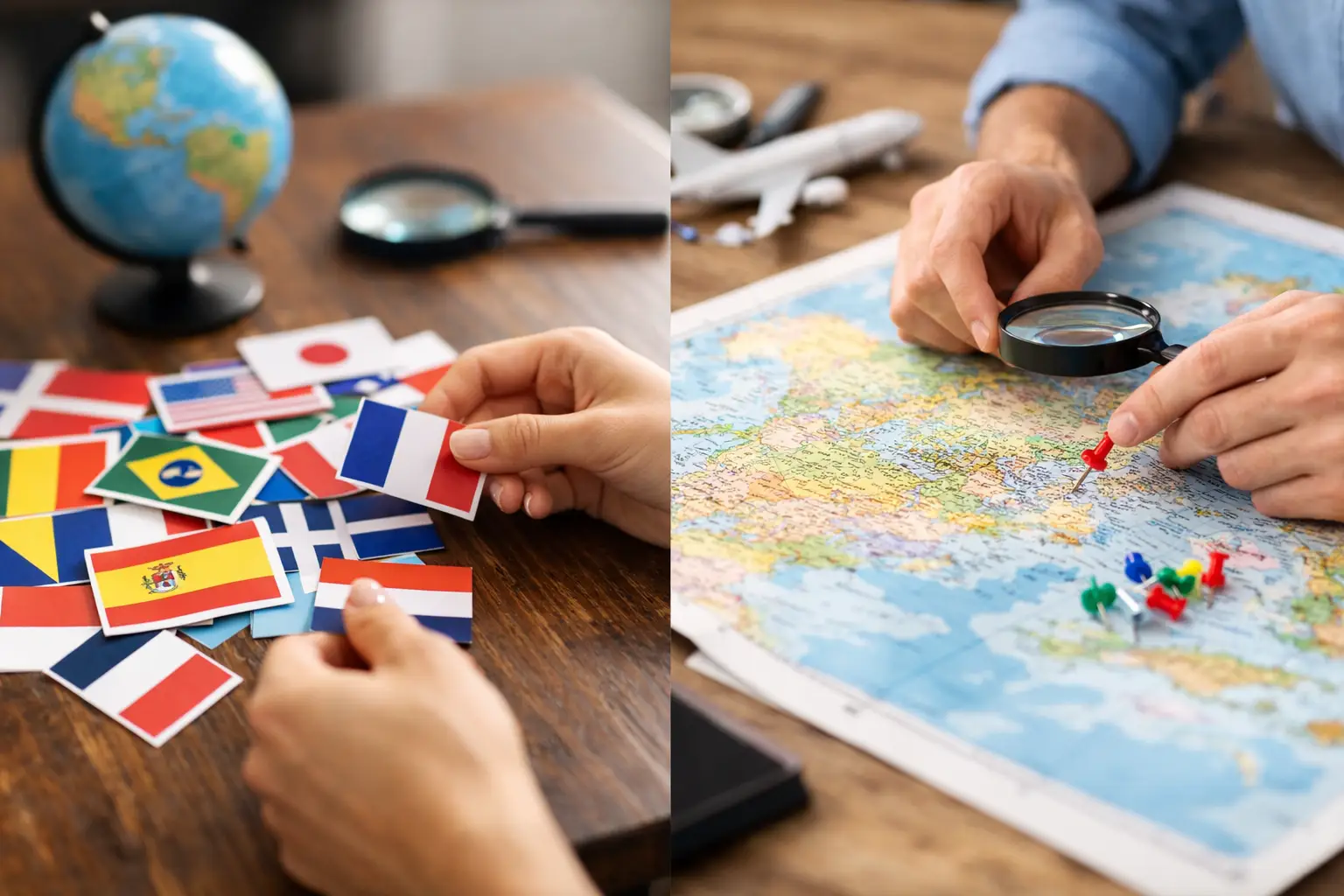
A flag game vs map game is not really a battle over which format is better. It is a choice between two different ways of seeing the world. One asks, “What does this country look like?” The other asks, “Where does this country belong?” Both can turn a few spare minutes into useful geography practice - but they train different instincts.
That difference matters when you want a daily game that stays fun after the first streak. If you love recognizing patterns, colors, and symbols, flags create fast visual wins. If you like clues, borders, regions, and spatial puzzles, maps give you a wider field to explore. The best choice depends on what you want to learn next.
Flag Game vs Map Game: The Core Difference
A flag game centers on visual identity. You might see a partially covered flag, a group of colors, or a single emblem and work backward to the country. The challenge is compact: notice details, eliminate possibilities, and make a smart guess before your tries run out.
A map game centers on location. You may need to identify a country’s outline, click its place on a blank map, or use distance and direction clues to narrow down a mystery country. It asks you to build a mental map of the world, not just a catalog of country names.
Think of flags as country faces and maps as country addresses. Knowing one without the other is still useful, but pairing them creates stronger recall. When you recognize the red circle of Japan and can also picture Japan off the eastern edge of Asia, the fact has more places to stick.
Why Flag Games Feel So Immediate
Flags are designed to be seen quickly. Strong color contrast, simple shapes, and recognizable symbols make them ideal for short daily challenges. A few seconds can be enough to spot the Nordic cross, a tricolor pattern, or a star arrangement that points you in the right direction.
That speed is a real advantage for casual players. There is no need to study a large map before making your first move. You can jump in, trust your visual memory, and learn from the reveal if you miss. The format works especially well for a daily puzzle because the rules are easy to remember: look closely, guess the country, try again if needed.
Flag games also make progress feel visible. At first, many flags may blur together. Then small details start standing out. You notice that Romania and Chad share similar vertical stripes, but their shades differ. You stop confusing Australia and New Zealand once you pay attention to the stars. Those moments turn passive recognition into active knowledge.
There is a trade-off. Flags can sometimes reward memorization more than geographic context. You may identify a flag correctly but still be unsure whether the country is in Central America, Southern Africa, or the Pacific. That is not a flaw. It simply means flags are strongest when your goal is visual country recognition.
What Map Games Teach That Flags Cannot
Map games make geography physical in your mind. A country is no longer just a name on a list. It has neighbors, a coastline or no coastline, a size, a shape, and a position relative to places you already know.
This is where map play becomes useful for travelers, students, trivia fans, and anyone trying to make world events easier to follow. When you hear about a country in a headline, location changes your understanding. Is it near a conflict zone? Does it border a familiar country? Is it an island nation? A map gives the name context.
Map games can also teach through logical deduction. If a mystery country is north of one guess, west of another, and thousands of miles away from a third, you can work toward the answer even before you recognize it. That makes the format satisfying for players who enjoy strategy as much as recall.
The challenge is that maps have a steeper starting curve. Small countries can be difficult to place, especially in crowded regions. Country outlines may look unfamiliar without labels. And clicking near the right spot is not always the same as knowing the answer. A good map game needs fair clues and clear feedback so a wrong guess still teaches something.
Choose a Flag Game When You Want a Fast Win
A flag game is usually the better fit when you have a minute or two and want a clean, focused challenge. It is also a strong starting point for newer geography players because flags give you a visible clue from the first second.
Choose flags when you want to sharpen visual memory, learn national symbols, or build confidence with country names. They are great for a quick school break, a coffee-line puzzle, or a friendly score share with someone who has never considered themselves good at geography.
The format is especially effective when it uses limited guesses. Three thoughtful attempts create just enough pressure to make the answer memorable without turning the game into homework. A missed flag becomes a tiny lesson, and tomorrow brings a fresh chance to use it.
Choose a Map Game When You Want Context
Choose a map game when your goal is to understand relationships between countries. You will get more out of maps if you enjoy working from clues, recognizing regional patterns, and slowly filling in gaps in your mental world map.
Maps are often more rewarding once you know some basics. If you can already name a handful of countries in each region, you can use that knowledge to reason through harder prompts. You might not know the answer immediately, but you can get closer by asking useful questions: Is it landlocked? Which sea is nearby? What countries border it?
This format can feel slower than a flag puzzle, and that is part of the appeal. It invites you to pause, compare, and connect facts. For teachers and students, it can be a smart follow-up to flag recognition because it turns “I know that country” into “I know where it is and what surrounds it.”
The Best Geography Habit Uses Both
You do not need to pick one format forever. In fact, alternating between flags and maps is one of the simplest ways to avoid shallow learning. A flag gives a country a distinct visual cue. A map gives it a location. Together, they create multiple paths back to the same answer.
Try a simple rhythm: play a flag challenge on one day, then test yourself on the map location the next day. If you miss a country, do not just memorize the correction. Notice one extra detail. Maybe its flag contains a cedar tree, it borders three countries, or it sits on an island chain. One connection is often enough to make the next encounter easier.
This approach also keeps daily geography games from becoming repetitive. Some days you will spot an answer instantly from a color pattern. Other days you will need to think through hemispheres, neighbors, and distance clues. The variety builds a broader skill set while keeping the experience light.
Flagdle works well in that kind of routine because it keeps the entry point simple: one shared daily flag, three tries, no account required. From there, other geography modes can help turn recognition into context when you are ready for a different challenge.
What Makes Either Game Worth Returning To
The strongest geography games do more than test what you already know. They show enough feedback to help you improve. After a guess, useful details might include the country name, the full flag, its capital, its region, or a map location. The point is not to overwhelm you with facts. It is to give each round a takeaway.
Fairness matters, too. A daily game should reward observation and curiosity, not obscure trick questions. There is nothing wrong with a hard flag or a tiny country, but players should have clues, patterns, or a reasonable path to learn from the result. That is what makes a streak feel earned rather than lucky.
Social play adds another reason to return. Comparing a score can start a conversation without requiring a long competition. Did you get it in one guess? Did a friend notice a symbol you missed? Shared daily puzzles work because everyone faces the same challenge, yet each person arrives at the answer differently.
The useful choice is the one you will actually play tomorrow. Start with flags if you want quick recognition. Reach for maps if you want location and strategy. Then let every correct answer - and every miss - add one more country to the version of the world you carry around with you.