Daily Flag Puzzle Guide for Better 3-Try Guesses
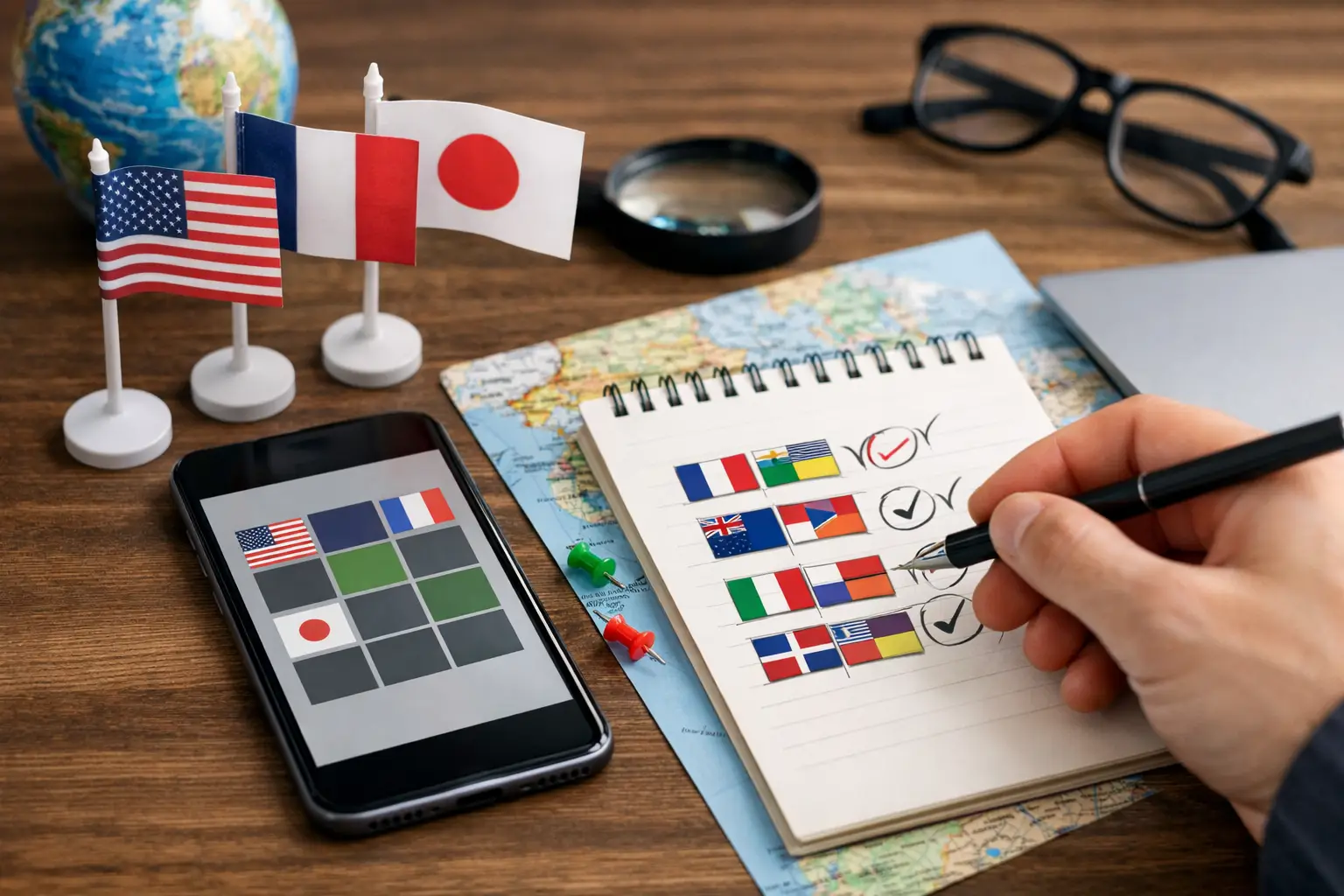
A flag appears with most of its design hidden, and you have three guesses to name the country. That is enough pressure to make even a familiar flag feel brand new. This daily flag puzzle guide helps you slow down just enough to spot the clues that matter, make each guess count, and turn a quick game into geography that sticks.
The goal is not to memorize every flag overnight. It is to recognize patterns, rule out unlikely answers, and learn something useful when the reveal arrives. A few seconds of sharper observation can make a big difference.
Daily Flag Puzzle Guide: Start With What You Can See
Before you name a country, identify the visible parts of the flag. Ignore the urge to guess from one color alone. Red, white, and blue appear on flags across every region, while green, yellow, and black can point in many directions too. A single color is a weak clue. A color combination plus a layout is much stronger.
Look first at the flag's structure. Are the stripes horizontal, vertical, or diagonal? Is there a cross, a triangle at the hoist, a large central emblem, or a single star? Even a narrow uncovered edge may reveal whether the design is built around bands, quarters, or a symbol.
Then notice the order of the colors. A blue-over-yellow flag suggests a very different set of possibilities than yellow-over-blue. A red field with a white cross is not the same puzzle as a white field with a red cross. Direction and placement matter as much as the palette.
Try describing the clue in plain language before guessing: “vertical green, white, and red,” or “blue field with a yellow shape near the center.” That small pause keeps your brain from jumping to the first familiar answer.
Read Design Clues, Not Just Colors
Many flags are visually related because of geography, history, religion, or political movements. That is useful, but it also creates traps. The fastest players do not just recognize a family of flags. They look for the feature that separates one family member from another.
Stripes can narrow the field
Tricolors are common, so count the bands and check their direction. Vertical tricolors often bring countries such as Ireland, Italy, France, Mexico, and Côte d’Ivoire into consideration. Horizontal tricolors open another group, including Germany, Hungary, the Netherlands, and Colombia.
Do not treat this as a final answer. Treat it as a shortlist. If the visible section includes a crest, a different shade, or an extra symbol, the obvious answer may be wrong. Mexico and Italy, for example, share a basic vertical color layout, but Mexico has a coat of arms in the center. A partial reveal can hide that detail, so use your next guess carefully.
Symbols often decide the puzzle
Stars, crescents, suns, crosses, shields, and coats of arms can turn a broad clue into a precise answer. A white crescent and star can suggest several countries, but their position, the background color, and any nearby stripes reduce the options quickly.
Pay attention to scale. A tiny star near a corner means something different from a large central star. A sun with many rays is not interchangeable with a plain yellow circle. If the game shows only part of a symbol, ask what kind of shape it could become rather than forcing it into the first symbol you recognize.
Small details are rarely random
A triangle at the left edge, a thin border, an unusual color like purple, or a detailed emblem is often the clue worth following. These features are less common than stripes and broad color blocks, so they carry more weight.
There is a trade-off here. Fine details can be hard to see in a partially hidden flag, especially on a small screen. When you are uncertain, do not build an entire guess around a blurry mark. Pair it with a clear structural clue first.
Use Your Three Guesses Like a Strategy
Three tries are enough when each guess has a job. Your first guess can be a confident answer, but it should also test your strongest theory. If you see a flag that appears to have a red field and a white cross, Switzerland may be a sensible first thought. If the reveal proves otherwise, compare what you expected with what is actually visible. Was the cross offset? Was the field more complex? That correction can point you toward another flag family.
Your second guess should be more selective. By now, focus on the detail that makes your original answer imperfect. Maybe the flag has the right colors but the wrong stripe direction. Maybe a visible shape rules out the country you had in mind. Use the miss to improve your logic instead of simply choosing another country with similar colors.
Save the third guess for the best remaining match, not a random long shot. If you truly cannot identify the flag, choose from the strongest pattern group you have built. A thoughtful wrong answer still trains recognition better than a rushed one.
A useful mental sequence is simple: observe, shortlist, compare, commit. It takes only a few seconds, and it prevents the most common mistake in daily flag games - guessing from a vague feeling.
Build Flag Memory Through Geography
Flags become easier when they are connected to places rather than stored as isolated images. When you learn a flag, attach it to a region, a neighboring country, a capital, a language, or a historical fact. The connection does not need to be complicated. It just needs to give your memory another route back to the answer.
For example, a Nordic cross immediately connects a design style to northern Europe. Pan-African colors can prompt you to consider African nations, while red, white, and blue tricolors may lead you toward Europe or the Americas. These are starting points, not rules. Plenty of flags break the pattern, and that is part of the fun.
After the answer is revealed, take ten extra seconds. Find the country on a mental map. Ask which nations border it, what region it belongs to, or what makes its flag different from a similar one. That short review is where a missed puzzle becomes a future solve.
Flagdle works especially well for this habit because the same daily puzzle gives everyone a shared answer to discuss. Compare approaches with a friend after playing. You may remember a flag more clearly when someone points out the triangle, symbol, or color order you missed.
Avoid the Most Common Flag Puzzle Mistakes
The first mistake is overconfidence with famous flags. A recognizable color pattern can make you answer too fast, even when the visible layout does not quite fit. Give familiar answers a quick fact check: Are the colors in the correct order? Is the symbol where it should be? Is there an extra stripe?
The second is treating similar flags as identical. Romania and Chad are the classic example of nearly matching vertical blue, yellow, and red tricolors. Other pairs differ by a coat of arms, a shade, a star, or a proportion that may be hidden at first. In these cases, the puzzle may depend on a clue you have not seen yet. Stay open to both possibilities.
The third is forgetting that flags change. Some countries have updated designs, and historical flags can linger in memory from old textbooks, sports broadcasts, or travel souvenirs. Daily puzzle games generally use current national flags, so trust the present-day version when your memory conflicts with the visible clue.
Finally, do not let a loss end the learning. The best daily games are repeatable because every incorrect answer adds a new association. Tomorrow’s flag may use the same shape, color family, or regional pattern.
Make It a Daily Geography Habit
A daily flag puzzle takes minutes, which is exactly why it can work. Play at the same point in your routine: with coffee, during a study break, or before you check the news. The consistent timing matters more than a long study session because repeated exposure builds fast visual recall.
If you want a little extra challenge, name one fact about the country after each reveal. It could be its capital, continent, a neighbor, or a language spoken there. Some days you will know it immediately. Other days, the answer will be the fact you carry forward.
Keep your guesses curious. A partially hidden flag is not a test of whether you already know everything. It is one small chance to see the map more clearly, one country at a time.