7 Best Daily Geography Games to Play Today
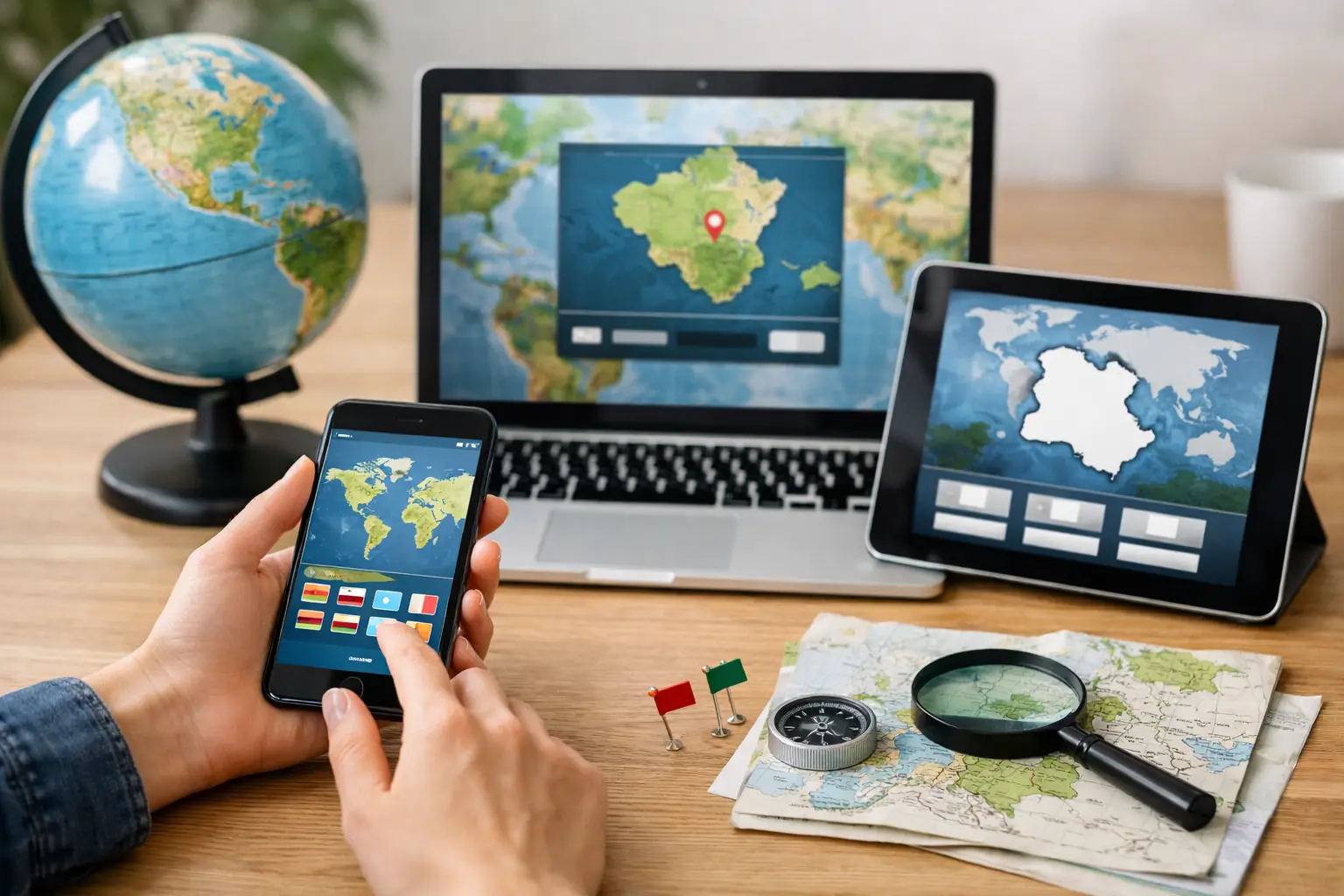
A good geography game gives you a small win in a few minutes: one country recognized, one capital remembered, one map clue that suddenly makes sense. The best daily geography games turn that feeling into a habit. They give everyone the same fresh puzzle, make progress easy to notice, and leave you knowing a little more than you did before.
The right game depends on what you want to practice. Flags build visual recognition. Map games sharpen location and scale. Country-guessing games reward logical elimination. Street-view challenges test observation, local clues, and a cool head when every road looks unfamiliar.
What makes a daily geography game great?
A daily format works because it keeps the challenge focused. You are not staring at an endless menu or trying to squeeze in an hour-long session. You get one puzzle, one score, and a reason to come back tomorrow.
The strongest games also have clear rules. You should understand your goal within seconds, whether that means naming a flag, finding a country silhouette, or narrowing down a mystery location. Good feedback matters too. A wrong answer should still teach you something: where the country sits, which direction to look next, or what feature separates it from a nearby place.
Here are seven daily games worth adding to your rotation.
7 best daily geography games
1. Flagdle for quick flag recognition
Flagdle is built for the moment when you want a fast challenge without downloading an app or creating an account. A partially hidden national flag appears, and you have three tries to identify the country. The same flag is presented to players around the world each day, so scores are easy to compare with friends.
Its strength is simplicity. Flags are visual, memorable, and surprisingly tricky when a familiar color pattern is missing its most recognizable detail. A daily flag puzzle can teach you to spot small clues: a coat of arms, the order of stripes, an unusual color combination, or a symbol that points to a specific region.
It is a great starting point for beginners, but it does not stay easy forever. If your flag knowledge is already strong, the limited guesses make each choice count.
2. Worldle for map shape and location clues
Worldle asks you to identify a country from its outline. After each guess, you receive distance and direction feedback that tells you how far away the target is and where to look next.
This is a smart fit for players who want more than recognition. You may know a country exists but struggle to picture where it sits. Worldle turns that gap into a practical map lesson. A guess in South America that points northeast can quickly narrow your next move toward the Caribbean, Central America, or the Atlantic.
The trade-off is that silhouettes can be unforgiving. Small island nations and similarly shaped countries can stump even experienced players. That is part of the appeal if you enjoy puzzle logic more than instant answers.
3. Globle for warm-and-cold country guessing
Globle uses a different kind of feedback. Guess a country, and the game shows how geographically close it is to the hidden answer. Hotter colors mean you are getting closer. Cooler colors mean you need a new part of the world.
The game feels less like a quiz and more like a search. It rewards broad geographic awareness, because a close guess can reveal a region before it reveals the exact country. You start making useful comparisons: Is this country close because it borders the answer, because it shares an island, or because it is across a narrow sea?
Globle can take longer than a three-guess puzzle, especially when the answer is in a region you do not know well. Play it when you have time to follow the clues rather than when you want a 60-second break.
4. Travle for route planning on a map
Travle challenges you to connect a starting country to a destination in as few border crossings as possible. It sounds simple until you realize that a route that looks direct may cross more countries than a clever detour.
This is one of the best ways to learn adjacency: which countries share a border, where water blocks a path, and why a small country can be strategically useful. It also makes maps feel connected rather than like a set of isolated shapes.
Travle works especially well for people who enjoy strategy games. The geography is real, but the puzzle is about efficiency. If you prefer guessing based on visual clues, it may feel more like planning than trivia.
5. GeoGuessr Daily Challenge for observation skills
GeoGuessr places you in a real-world street-view setting and asks you to find your location. The Daily Challenge gives players a shared set of rounds, usually across very different places and landscapes.
This is geography at street level. Road markings, driving sides, vegetation, utility poles, architecture, language fragments, and license plate styles can all become clues. A strong round feels like solving a tiny detective case.
It is also the most demanding game on this list. Success can rely on specialized clue knowledge, and the experience can be more involved than a quick daily word puzzle. Still, for travelers, visual learners, and competitive players, it offers a level of variety that country-only games cannot match.
6. Statele for U.S. map practice
Statele brings the daily silhouette format to the United States. You see an outline and try to identify the state, often with limited guesses and directional hints.
For U.S. players, this is an easy way to strengthen a skill that many people assume they already have. Everyone recognizes Texas and Florida. The real test begins with the rectangular states, the smaller Northeast shapes, and the states whose borders only make sense once you have seen them enough times.
Statele is narrower than a world geography game, which is exactly why it works. Students preparing for a U.S. geography quiz and adults who want a fast daily challenge can build confidence quickly.
7. Countryle for clue-based country knowledge
Countryle adds facts to the guessing format. Instead of relying only on location, you use clues such as population, area, hemisphere, continent, language, or other country characteristics to eliminate possibilities.
This format is useful because geography is not just memorizing where countries are. It is also understanding how places differ. A small, densely populated country in the Northern Hemisphere creates a very different search than a large, sparsely populated country in the Southern Hemisphere.
The game is best for players who like deduction. You will learn faster if you pause after each clue and ask why it rules countries in or out. Guessing randomly gets you through a puzzle. Reasoning through the clues builds knowledge you can reuse.
Pick a game based on the skill you want to build
If you want the fastest possible daily ritual, choose a flag or silhouette game. These are easy to start during a coffee break, between classes, or while waiting for something else to load. Flag puzzles are particularly good for building recognition without making the experience feel like studying.
For stronger world-map awareness, choose Worldle, Globle, or Travle. They teach location differently: Worldle teaches direction and distance, Globle teaches proximity, and Travle teaches borders. Rotating among them prevents you from getting good at one type of clue while missing the bigger geographic picture.
Choose GeoGuessr when you want a deeper challenge. It takes more attention, but it can make the world feel more specific. Instead of seeing a country as a shape on a map, you notice its roads, signs, climate, and everyday visual patterns.
Make your daily games teach you more
The quickest way to improve is to treat the answer screen as part of the game. When you miss a country, take ten extra seconds to locate it on a map and notice one nearby country, body of water, or capital. That tiny review turns a wrong answer into a useful memory.
It also helps to avoid playing the same format every day. A player who only practices flags may recognize Botswana instantly but still hesitate to place it on a map. A player who only uses map clues may know the region but not recognize the national symbol. Mixing formats connects the visual, factual, and spatial parts of geography.
Keep it light. A streak is motivating, but it should not turn into homework. One thoughtful puzzle a day is enough to make your mental map noticeably sharper over time. Tomorrow's country is waiting.