How to Memorize Country Flags Without Cramming
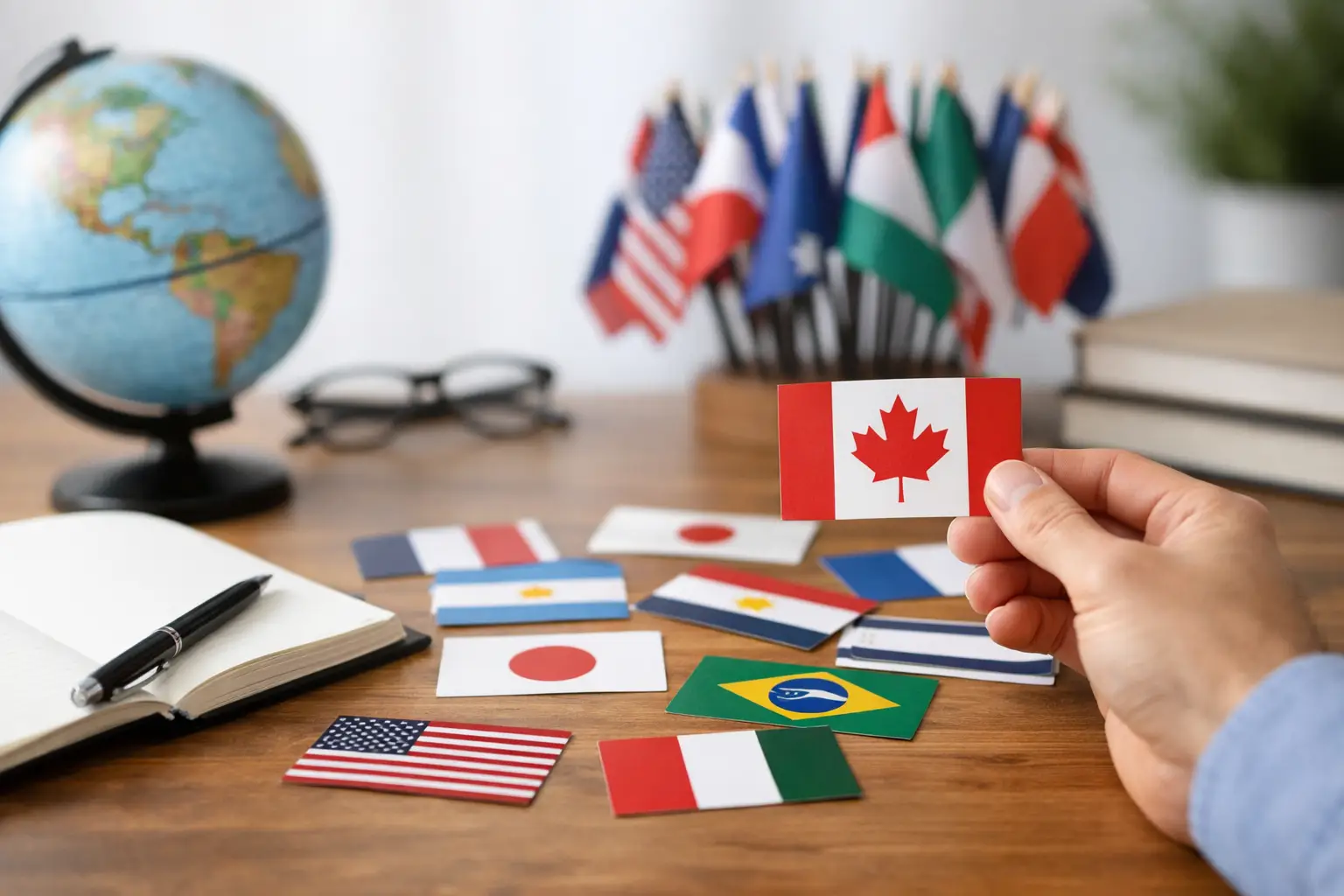
A flag can look like a few simple shapes until you have to tell Chad from Romania or Indonesia from Monaco. The fastest answer to how to memorize country flags is not staring at a giant chart until the colors blur. It is giving each flag a small, memorable story, then testing yourself often enough for that story to stick.
Flags are made for quick recognition. They use limited colors, bold symbols, and repeated patterns. That is good news: your brain does not need to store 190-plus random images. It needs a system for noticing the details that separate similar flags.
How to memorize country flags with patterns
Start by sorting flags into visual families. This lowers the number of decisions you make each time you see one. Instead of thinking, “Which country is this?” begin with, “What kind of flag is this?”
A vertical tricolor is one family. France, Italy, Ireland, Belgium, and Romania all fit the pattern, but their color order tells the real story. Horizontal tricolors form another group, including Germany, Hungary, the Netherlands, and Russia. Nordic crosses, crescent flags, star-filled flags, and flags with a coat of arms each create their own useful category.
This approach works because recognition comes before recall. When you see blue, yellow, and red vertical stripes, your brain can quickly narrow the field to Romania or Chad rather than searching every country at once.
Do not try to learn every family in one sitting. Pick one group, get comfortable with it, and move on. Five flags you can recognize reliably are more useful than 30 flags you have only glanced at.
Notice the detail that does the separating
Similar flags are where most players lose points. Give yourself one specific difference to look for.
Romania and Chad both use blue, yellow, and red vertical stripes. Romania’s blue is typically brighter, while Chad’s is darker, but screen colors can vary. The more dependable clue is context: Romania is in Europe, Chad is in central Africa. If you pair the design with the map, the distinction becomes easier to retrieve.
Indonesia and Monaco are both red over white. Indonesia has a wider, 3:2 shape, while Monaco is closer to square. Poland flips the colors to white over red. Keep that comparison as a three-flag set rather than learning each one alone.
Ireland and Ivory Coast also reward close attention. Both are green, white, and orange vertical tricolors. Ireland runs green-white-orange from left to right; Ivory Coast reverses it to orange-white-green. A simple cue helps: Ireland starts with green, like its familiar green landscape.
Build memorable anchors, not trivia overload
A flag becomes easier to recall when one feature has meaning. The goal is not to memorize every official design explanation. That can be interesting, but it is often too much information for a quick game. Find one anchor that lets you identify the flag in seconds.
Japan is the cleanest example: a red sun on white. Canada is a red maple leaf. Brazil is the green flag with a yellow diamond and blue globe. Nepal is the only national flag that is not a rectangle. These are high-confidence anchors, and they create early wins.
For less obvious flags, connect the design to a visual phrase. South Korea has a red-and-blue circle with black trigrams. Jamaica has a gold X across green and black. The Bahamas has a black triangle pointing toward aqua and gold bands. Your phrase does not need to be historically perfect. It only needs to help you retrieve the right country.
Be careful with made-up mnemonics that are too elaborate. If you need to remember a six-step story about a pirate, a pineapple, and a train station, you have added more to memorize than the flag itself. Short and visual beats clever and complicated.
Learn flags by region, then mix them up
Regional learning gives designs a second layer of context. A flag is easier to place when it belongs to a mental map.
Try a small session with one region, such as South America. You will notice repeated colors and ideas: Colombia, Ecuador, and Venezuela share yellow, blue, and red; Argentina and Uruguay both feature a sun; Brazil stands apart immediately. Once those flags feel familiar, test yourself with a mixed set from multiple regions. That last step matters because real recall rarely arrives in neat geographic batches.
A useful rhythm is to learn a region on one day, review it the next day, and mix it with older flags after that. This is spaced repetition in plain language. You revisit a flag just as it starts to feel less certain, which strengthens the memory more than rereading it several times in a row.
If you are studying for a class or quiz, start with the countries most likely to appear. If you are playing for fun, start with regions you travel to, follow in sports, or hear about in the news. Personal relevance makes the first memory hook stronger.
Use active recall to make flags stick
Looking at a flag and thinking, “I know that one,” can be misleading. Recognition is easier than producing the answer with no prompt. Active recall closes that gap.
Cover the country name and say it out loud. Look at the country name and sketch the flag from memory. Or describe the flag before checking the answer: “Three horizontal stripes, black-red-yellow.” Each method forces your brain to retrieve, not just recognize.
Daily games are particularly good for this because they keep practice short and repeatable. A game such as Flagdle gives you one focused challenge, partial visual information, and a reason to make a real guess. Whether you get it in one try or three, the correction arrives right after the attempt, when it is most useful.
A five-minute routine is enough. Spend two minutes on new flags, two minutes recalling flags from earlier in the week, and one minute reviewing mistakes. Consistency matters more than marathon sessions. Fifteen distracted minutes once a month will not beat five focused minutes most days.
Turn wrong answers into comparison cards
Your mistakes are not a reason to restart from zero. They are a custom study list.
When you confuse two flags, write them beside each other and name the difference in one sentence. For example: “Austria is red-white-red; Latvia is dark red-white-dark red with a thinner white band.” Or: “Australia has the Union Jack and large Commonwealth Star; New Zealand has four red stars with white borders.”
This is more efficient than reviewing flags you already know. The difficult pairs deserve the extra attention because they are where your memory needs a sharper edge.
Sketching works, even if your drawing is bad
You do not need art skills to learn flags. A rough sketch makes you process stripe direction, symbol placement, and proportion. That is much deeper than passively scrolling through images.
Draw a few flags from memory on paper or a blank digital canvas. Then compare them with the real versions. Did you put the star in the center when it belongs near the hoist? Did you reverse the stripe order? Those small corrections become strong cues for next time.
For detailed flags, do not obsess over every tiny emblem at first. Learn the broad identity before the fine print. Mexico is green-white-red with an emblem in the center. Spain is red-yellow-red with a coat of arms toward the left. You can refine the symbols later once the main structure is automatic.
A simple flag memory routine
Keep your practice light enough that you will actually return tomorrow. Choose six to 10 flags at a time. First, group them by pattern. Next, give each one a short anchor. Then test yourself without labels and save any confusing pair for a quick comparison review.
After a few days, shuffle old and new flags together. This is where progress becomes real. You are no longer remembering a sequence from a study sheet. You are identifying a country from its visual signals, the same way you will encounter it in a quiz, classroom, or daily puzzle.
Start with one flag today, make a guess before you look it up, and notice the one detail that makes it impossible to confuse next time.