How Daily Games Build Student Geography Progress
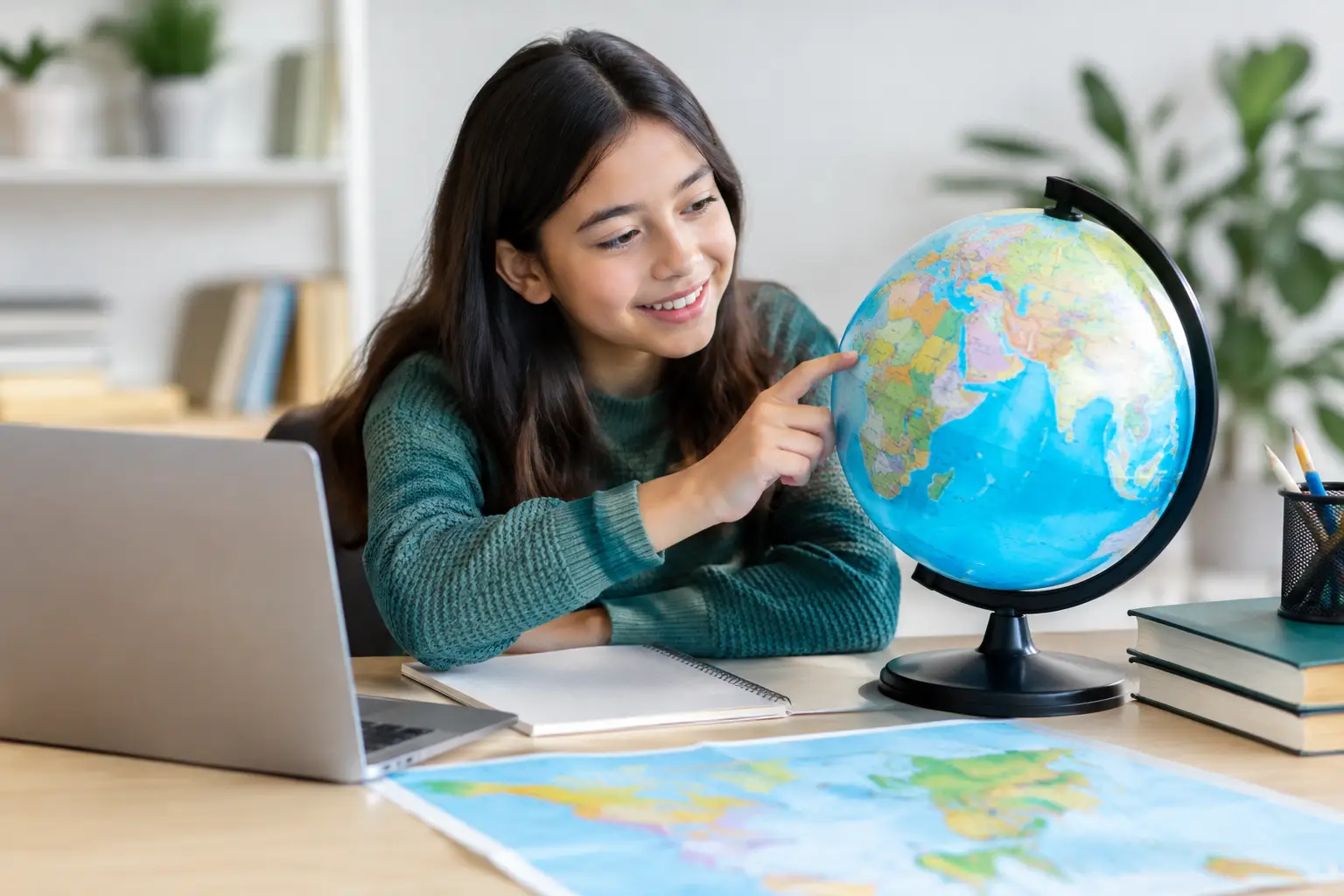
A student who can find Brazil on Monday and recognize its flag on Friday is making real student geography progress. It may look like a quick game, but each correct guess connects a place, a visual clue, and a memory. Repeat that process often enough, and geography stops feeling like a stack of facts to memorize.
The best part is that progress does not require an hour-long study session. A few focused minutes can build familiarity with countries, capitals, regions, borders, and flags. The key is using those minutes in a way that asks students to remember, not just reread.
Why geography progress is easy to miss
Geography learning is rarely a straight line. A student may identify Japan immediately, confuse Chad and Romania, then suddenly recognize a pattern in a group of Central American flags. That is normal. World knowledge grows through small corrections.
Traditional worksheets can show whether a student got an answer right once. They do not always show whether the answer will still be there next week. Short, repeatable challenges reveal something more useful: whether recognition is getting faster, guesses are becoming more informed, and mistakes are becoming less random.
That matters because geography is a connected subject. Knowing where Kenya is can make it easier to understand the Horn of Africa. Recognizing a country’s flag can lead to its capital, neighboring countries, languages, climate, or current events. One answer creates a hook for the next.
Build student geography progress with recall
The difference between seeing a map and using a map is active recall. Seeing a labeled map feels familiar. Being asked to point to Laos, name the capital of Peru, or identify a flag with the emblem hidden requires the brain to retrieve information.
Retrieval is harder, which is exactly why it works. A quick country game creates a useful pause: students look at a clue, make a choice, get feedback, and adjust. Even an incorrect guess can help if the answer is shown clearly and the student gets another chance to meet that country later.
Daily play adds spacing. Instead of cramming 30 countries before a quiz, students return to a small challenge over many days. That gives memories time to settle and makes the next encounter feel more familiar. A student may not remember Kyrgyzstan after one round. After seeing its name, location, and flag in several contexts, they are much more likely to keep it.
Make the challenge small enough to repeat
A geography activity should feel easy to start. If students have to create an account, install an app, or set aside a large block of time, many will skip it. A simple daily challenge removes that friction.
Three guesses at a partially hidden flag, one capital question, or a mystery country clue can be enough. The goal is not to cover the entire map before lunch. The goal is to build a habit students will actually continue.
This is where game design helps. A new puzzle each day gives students a reason to return, while a shared challenge gives them something specific to compare. They can say, “I got it in two,” or explain why a clue pointed them toward a region. Friendly competition makes recall more memorable without turning every wrong answer into a failure.
Use more than one geography clue
Flags are powerful visual shortcuts, but geography progress gets stronger when students meet countries from different angles. A student who only learns flags may know a design without knowing where the country is. A student who only drills capitals may memorize names without building a mental map.
Mixing challenge types creates stronger connections. Flag identification builds visual recognition. Capital questions connect place names. Distance and direction games build spatial reasoning. Country hints can add context through language, landmarks, borders, or geographic features.
The trade-off is simple: variety is useful, but too much variety at once can feel scattered. For younger students or beginners, start with one mode for a week, then add another. For advanced students and trivia fans, mixing modes keeps familiar material from becoming automatic.
A platform such as Flagdle works well in this kind of routine because students can move from a daily flag puzzle to other country-based challenges without adding extra setup. The game is short, free, and available in a browser, so the focus stays on the question rather than the process around it.
Track the signals that matter
Student geography progress is not just a percentage score. Accuracy matters, but it is only one signal. A better picture comes from looking at how students approach the challenge over time.
Are they making fewer wild guesses? Are they using color patterns, symbols, neighboring countries, or directional clues? Can they explain why an answer is likely? Are they returning voluntarily? Those are signs that geography knowledge is becoming usable.
For teachers, a lightweight weekly check can be more valuable than a high-pressure test. Ask students to name three countries they learned, locate one on a map, and share one clue that helped them remember it. This turns a daily game into a short reflection without draining the fun from it.
For families, the conversation can stay casual. Ask, “What country came up today?” or “What was your first guess?” There is no need to correct every detail on the spot. Let curiosity lead, then look at the map together when a question comes up.
Celebrate better thinking, not just perfect scores
A perfect streak feels good, but it is not the only win. If a student guesses a country in the right region, notices a coat of arms, or rules out an answer based on a capital clue, they are learning how to think geographically.
This is especially helpful for students who worry they are “bad at geography.” They do not need to memorize every country before participating. A daily puzzle gives them a manageable problem, immediate feedback, and another chance tomorrow. Over time, the map becomes less intimidating because it is no longer one enormous thing to learn.
Keep geography connected to the real world
Country knowledge sticks best when it has somewhere to go. When a place appears in the news, sports, music, food, travel, or history, students with a basic mental map have a starting point. They can place the story instead of treating the country name as a distant label.
Teachers can make this connection in minutes. If a country appears in a daily challenge, ask one follow-up question: What region is it in? What countries border it? What language is widely spoken there? What is one physical feature nearby? One question is enough to add depth.
It depends on the classroom goal. If the focus is quick engagement, keep the game fast and let students enjoy the puzzle. If the focus is assessment or a larger unit, use the daily challenge as an opening activity and build a map, research prompt, or discussion around it. Both approaches have value.
The point is not to turn every game into homework. It is to give students more chances to notice the world, make a prediction, and remember one more place than they did yesterday. Put a small geography challenge in front of them each day, and let the map slowly become familiar territory.