Flags of the World: How to Read Them
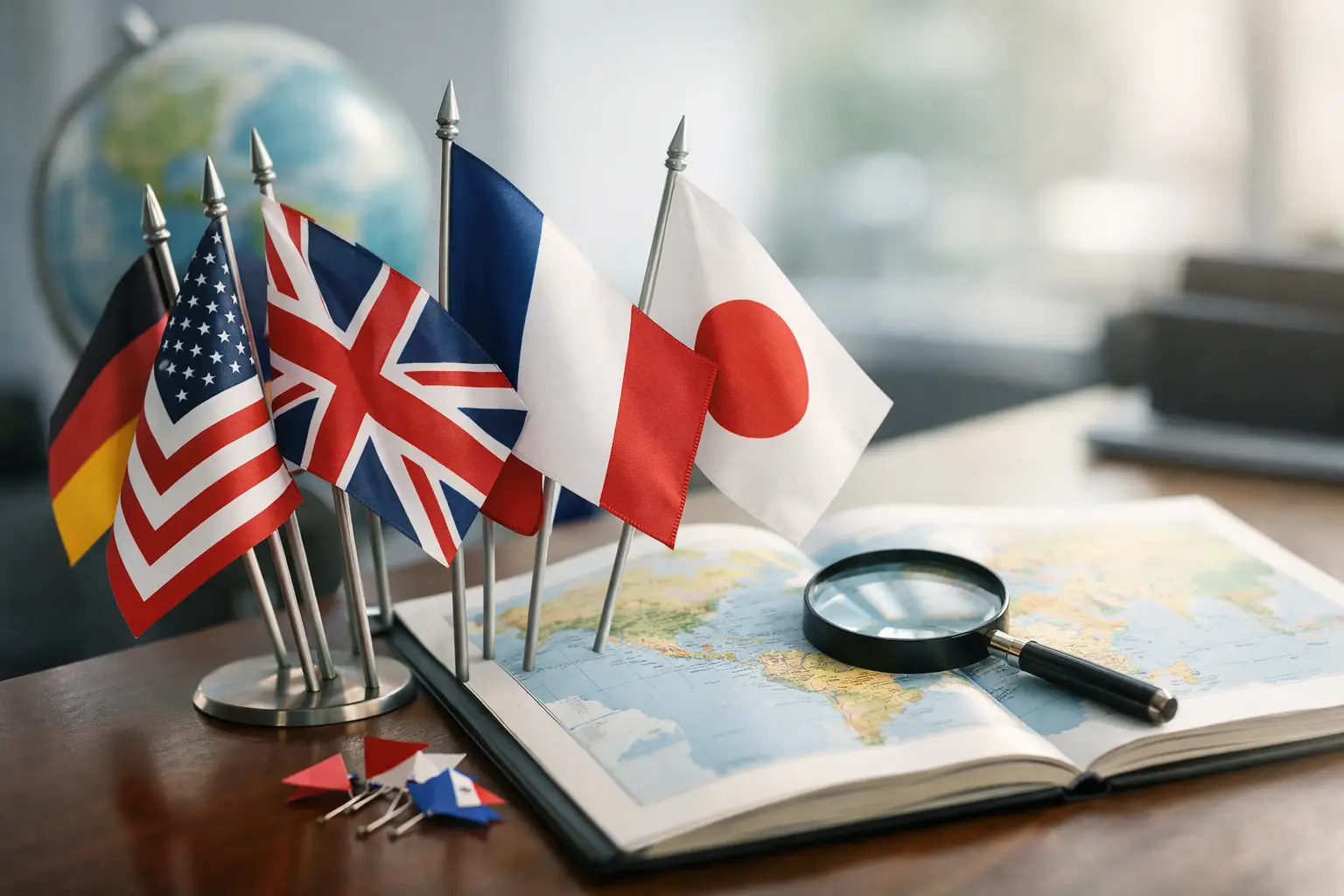
You can learn a lot from a rectangle of color in about two seconds. That is part of what makes flags of the world so addictive. One glance can trigger a country name, a region, a language family, a political history lesson, or that annoying feeling that you know this flag but cannot quite place it.
That mix of speed and memory is why flags work so well as a daily challenge. They look simple at first. Then you start noticing how much information is packed into a few stripes, stars, crosses, suns, crescents, and coats of arms. The more you play with them, the more your brain starts grouping patterns and spotting the small details that matter.
Why flags of the world are harder than they look
A lot of people assume flags are easy because they are designed to be recognizable from far away. Sometimes that is true. Japan is hard to confuse. Canada is pretty friendly too. But once you move beyond the most famous examples, things get tricky fast.
Many countries share the same core colors. Red, white, and blue show up everywhere. So do horizontal tricolors. So do stars. If you rely on color alone, you will mix up Luxembourg and the Netherlands, or Romania and Chad, or Indonesia and Monaco. Flags reward attention, not just familiarity.
That is also what makes them fun. They are visual puzzles with just enough repetition to feel learnable. You do not need to memorize 190-plus designs all at once. You just need to get better at seeing the clues.
How to spot patterns in flags of the world
The fastest way to improve is to stop looking at each flag as a one-off image. Start looking for families.
Color families tell you where to look
Pan-Arab colors - red, white, black, and green - appear across much of the Middle East and North Africa. Pan-African colors often feature red, yellow, and green, though there are variations. Slavic flags commonly use white, blue, and red. Once you know those broad groupings, a flag stops being random. It starts narrowing the field.
This does not mean every flag in a color family belongs to the same region or history. It means your brain gets a shortcut. Instead of guessing from the entire map, you start with a smaller neighborhood.
Layout matters more than people think
Horizontal stripes feel different from vertical stripes. A triangle at the hoist immediately changes the possibilities. A Nordic cross points you toward one set of countries. A centered emblem suggests something different from a tiny canton in the top-left corner.
Think of layout as grammar. The colors are vocabulary, but the arrangement is what makes the sentence readable.
Symbols are clues, but only if you notice the details
A single star is not the same as a ring of stars. A crescent with a star suggests different traditions than a sun with many rays. Even the number of points on a star can help. The shape of a leaf, the style of a crest, or the presence of a weapon, bird, or shield can separate one close match from another.
When people miss a flag, it is often because they saw the big pattern but skipped the final detail.
The most common flag mix-ups
Some flags are famous for causing trouble, and for good reason.
Romania and Chad are nearly identical at a glance. Indonesia and Monaco differ mainly in proportion and shade. Australia and New Zealand both feature the Union Jack and stars, but the star arrangement is different. Norway, Iceland, Finland, Sweden, and Denmark all use the Nordic cross, so you need to lock in the color combinations.
Then there are the flags that feel familiar because they borrow from shared regional history. Several Arab states use similar bands of color. Many African flags echo independence-era symbolism. A lot of European flags look simple until you are under time pressure and suddenly every tricolor looks like every other tricolor.
That is why guessing by vibes only works until it really does not.
How to remember flags without brute-force memorization
You do not need flashcards for every country if that is not your style. Most people remember flags better when they attach one visual anchor to each design.
Build one strong association
For Canada, it is the maple leaf. For Japan, the red circle. For Brazil, the yellow diamond on green. For South Africa, the Y-shape. The point is not to create a perfect historical explanation every time. The point is to give your memory something sticky.
For trickier flags, focus on one odd feature. Nepal is not rectangular. Qatar has a serrated white band and a darker maroon field. The Bahamas has a black triangle and bright aqua stripes. Those details make recall faster.
Learn in clusters, not in isolation
Studying neighboring or similar-looking flags together works better than random order. If you compare the Baltic flags side by side, or the Nordic flags together, or the red-white-blue tricolors in one session, your brain starts noticing contrasts.
That contrast is what helps memory last. You stop thinking, this is another striped flag, and start thinking, this is the one with the lighter blue, or the one with the central coat of arms, or the one with the triangle.
Use repetition that feels like a game
The best practice is short and repeatable. A few minutes a day beats one giant cram session. That is one reason daily geography games work so well. You get a small challenge, immediate feedback, and a reason to come back tomorrow.
Flagdle fits that rhythm nicely because it keeps the task simple - guess today’s flag, compare your score, move on a little sharper than you started.
What flags can and cannot teach you
Flags are a great entry point for geography, but they are not the whole subject.
A flag can help you remember that a country exists, where it roughly belongs, and what symbols it wants to present to the world. It can hint at religion, political movements, colonial history, independence struggles, or regional alliances. That is useful. It turns abstract country names into something visual and memorable.
But flags also flatten complexity. They are official symbols, not complete portraits. Two countries may use similar colors for totally different reasons. A national emblem may reflect one era more than another. Some flag designs are beloved. Others are debated. Some have changed with regime shifts, revolutions, or independence.
So if you get interested in a flag, that is the real win. It means the image did its job and pulled you toward the story behind it.
A quick way to get better at flags
If your goal is simple improvement, keep your process simple too. Start with the flags you already know. Then add the most commonly confused pairs. After that, work by region. Give yourself permission to miss a few. The mistakes are part of the pattern training.
When you guess wrong, do not just move on. Ask what fooled you. Was it the stripe order? The shade of blue? The position of the symbol? That tiny post-guess review is where a lot of learning happens.
Why this challenge keeps pulling people back
Flags sit in a sweet spot between trivia and instinct. They are visual, fast, and just difficult enough to make a correct answer feel earned. You can play for 30 seconds and still learn something. You can compete with friends without needing a huge time commitment. And because there is always another country you almost know, the next round is easy to justify.
That is a rare combination. Most internet distractions make you feel like time disappeared. A good flag challenge gives you a small win, a sharper eye, and one more piece of the map that now feels familiar.
Next time a flag stumps you, slow down for one extra second. Count the stripes, check the symbol, notice the shape, and trust the pattern before the panic. That is usually when the answer shows up.