World Geography Classes That Actually Stick
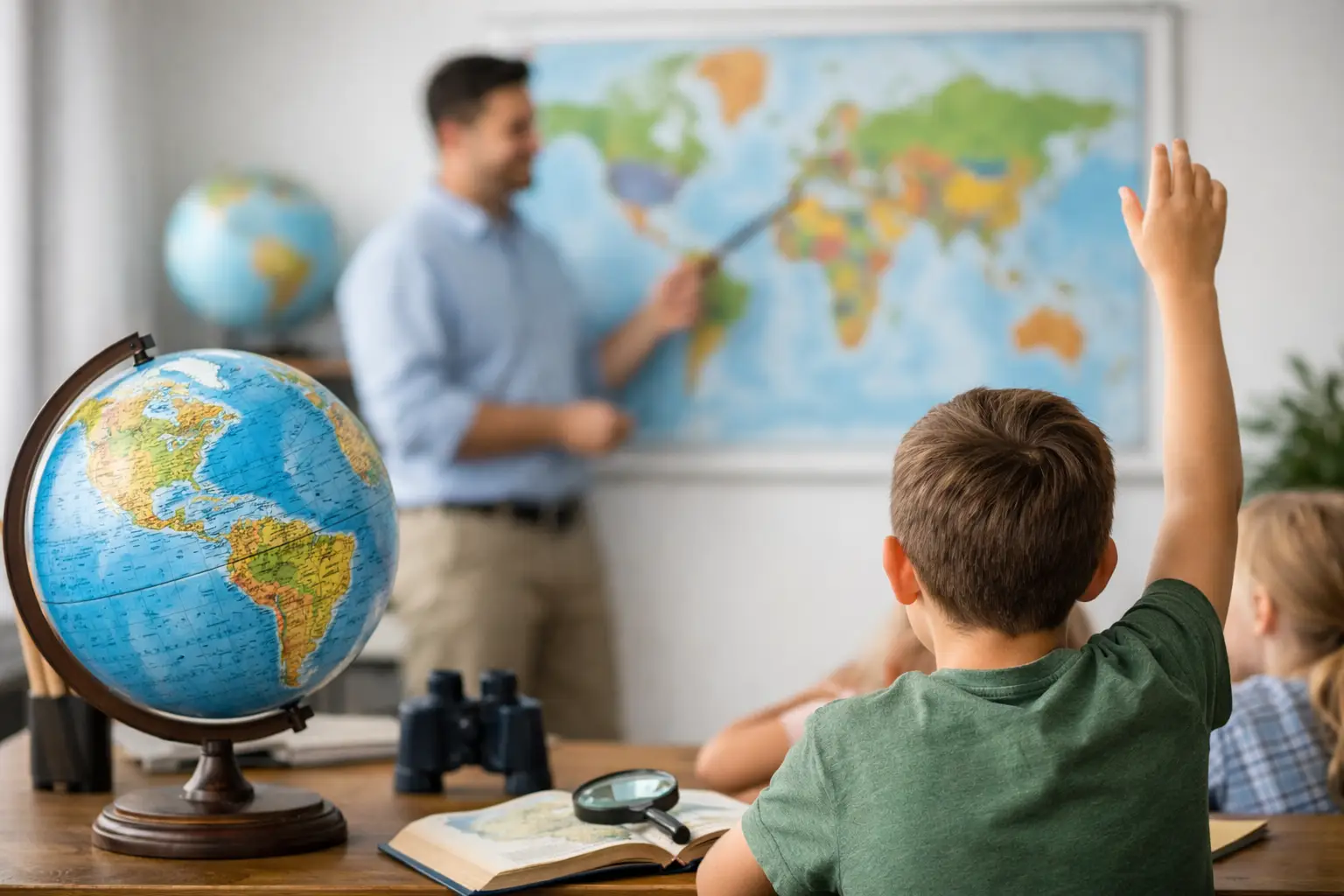
A lot of people can point to Italy on a map but freeze when asked about Kyrgyzstan, Benin, or Suriname. That gap is exactly why world geography classes matter. Done well, they build more than map skills. They help students notice patterns, connect places to people, and make sense of news, culture, travel, and history without turning the subject into a memorization slog.
The problem is that geography often gets taught like a storage test. Memorize capitals. Label rivers. Match countries to continents. Then forget half of it by next month. Students are not wrong to tune out when the lesson feels like pure recall with no payoff.
The better version of geography class feels different right away. It asks students to infer, compare, guess, and revise. It makes room for curiosity. And it turns the world from a flat worksheet into a set of connected clues.
Why world geography classes often miss the mark
The usual issue is not the content. The world is already interesting. Borders shift, languages spread, climates shape daily life, and cities grow for reasons that are rarely random. The issue is delivery.
When world geography classes focus too heavily on isolated facts, students may pass a quiz without building a mental map. They know a capital name for a day, but they do not understand why a country’s location matters, who its neighbors are, what trade routes shape it, or how landforms influence culture and conflict.
There is also a pacing problem. Geography gets compressed. Teachers are expected to cover continents, regions, physical systems, human migration, economics, and current events in limited time. That creates a trade-off. Move too fast, and students retain almost nothing. Slow down too much, and coverage gets thin.
So the goal should not be to cram every fact into one course. The goal should be to make geography memorable enough that students keep building on it later.
What makes world geography classes actually work
The strongest classes usually combine three things: visual repetition, context, and low-stakes challenge.
Visual repetition matters because geography is spatial. Students need to see the same regions in different ways - political maps, physical maps, population maps, language maps, and climate maps. When they encounter a country repeatedly across different frames, it stops being an abstract label and starts becoming a real place.
Context matters because facts by themselves are fragile. It is easier to remember that Nepal sits in the Himalayas than to memorize its location as a random item. It is easier to remember that Singapore became a major global hub because of where it sits than to treat it as just another city-state to identify on a test.
Low-stakes challenge matters because active recall beats passive review. If students have to guess, compare, and correct themselves, they learn faster. A daily geography puzzle, a map sprint, or a quick flag challenge often does more for retention than another round of reading definitions.
That does not mean every class needs to become a game show. It means the learning loop should have friction in the right place. Students should have to think, but not so much pressure that they stop trying.
A smarter format for teaching geography
A useful geography lesson usually starts narrow, then expands. Begin with a country, city, flag, or border. Then pull outward into region, environment, economy, and culture.
For example, if the class starts with Morocco, the lesson can move quickly from identifying it on a map to asking why it feels different from much of sub-Saharan Africa, how its location near Europe shapes trade and migration, and why the Strait of Gibraltar matters. One place opens several doors.
This approach works better than teaching giant categories in the abstract. Students can understand globalization more easily when they see it operating through one port city. They can understand climate pressure more clearly when they look at one drought-prone region and the people adapting to it.
That is also why short recurring activities help. A five-minute daily challenge creates continuity. Students do not need a full lecture every time to sharpen recognition and recall. They just need consistent exposure.
Games are not a gimmick here
Some educators still treat play as a reward rather than a teaching method. In geography, that is a mistake.
Guessing a country from a partial flag, identifying a nation from directional clues, or narrowing down a mystery place from hints all train real geographic thinking. Students are learning elimination, region recognition, pattern spotting, and memory. They are not just passing time.
The key is design. If a game is pure speed with no feedback, the learning value drops. If it gives useful correction, reveals the answer clearly, and encourages repeat play, it becomes a strong microlearning tool. That is why daily formats work so well. One puzzle is quick. A month of them builds durable knowledge.
For teachers, this is practical. You can use geography games as a warm-up, exit ticket, or homework starter without adding much prep. For students and casual learners, it feels lighter than formal study but still adds up. That blend is the sweet spot.
Platforms like Flagdle fit nicely into this kind of routine because they remove friction. No account, no download, no long setup. Just one challenge and an immediate reason to pay attention.
What students should get from world geography classes
A good course should leave students with more than a stack of remembered names. They should finish with a stronger sense of scale, region, and connection.
Scale sounds simple, but it changes how people understand the world. Students should know that Africa is much larger and more varied than many map projections make it seem. They should understand that island nations are not all tiny in the same way, and that distance on a map can mean something very different depending on terrain, infrastructure, and political boundaries.
Region matters too. Students should be able to make informed guesses. If they see a flag, climate description, or language clue, they should have some sense of where a place might be and why. That kind of reasoning is more useful than perfect recall of every capital.
Connection is the big one. Geography explains why some cities become trade centers, why migration routes form, why conflicts cluster in certain areas, and why environmental change hits some populations harder than others. Once students see those links, geography stops feeling like a side subject and starts feeling like a framework.
The trade-offs teachers and learners should expect
There is no perfect model for world geography classes because the audience changes everything.
Middle school students may respond best to quick visual recognition and repeated map work. High school students can usually handle more comparison, current events, and cause-and-effect thinking. Adult learners often want practical relevance - travel, headlines, culture, and global literacy - more than formal assessment.
There is also a balance between breadth and depth. Cover every country too quickly, and students blur them together. Focus deeply on a few places, and they may miss the wider structure of the world. The answer is usually a mix: broad exposure supported by a few memorable deep looks.
And yes, memorization still has a role. You do need some foundational recall. Students should know major countries, continents, oceans, and world regions without having to reinvent that knowledge each time. But memorization should support understanding, not replace it.
How to make geography stick outside the classroom
The best geography learning often happens in short bursts. A two-minute challenge before class. A quick comparison of two neighboring countries. A habit of checking where a headline is happening before reading the article.
That is one reason daily geography formats have taken off. They match real attention spans. They make repetition painless. And they create a tiny shared event - the same puzzle, the same reveal, the same chance to compare scores with friends or classmates.
For independent learners, this matters just as much as it does for schools. Most adults are not signing up for a semester-long course. They are far more likely to learn through a repeatable habit that feels fun enough to keep doing.
That may be the clearest lesson for anyone designing or taking world geography classes: make the world easier to revisit. If the subject only appears in dense units and high-pressure tests, it fades. If it shows up often, in small, engaging formats, people keep it.
Geography gets interesting fast when learners stop asking, “Will this be on the quiz?” and start asking, “Wait, where is that?” Build around that moment, and the class has a real chance to last.