Why World Geography Education Sticks Better as Play
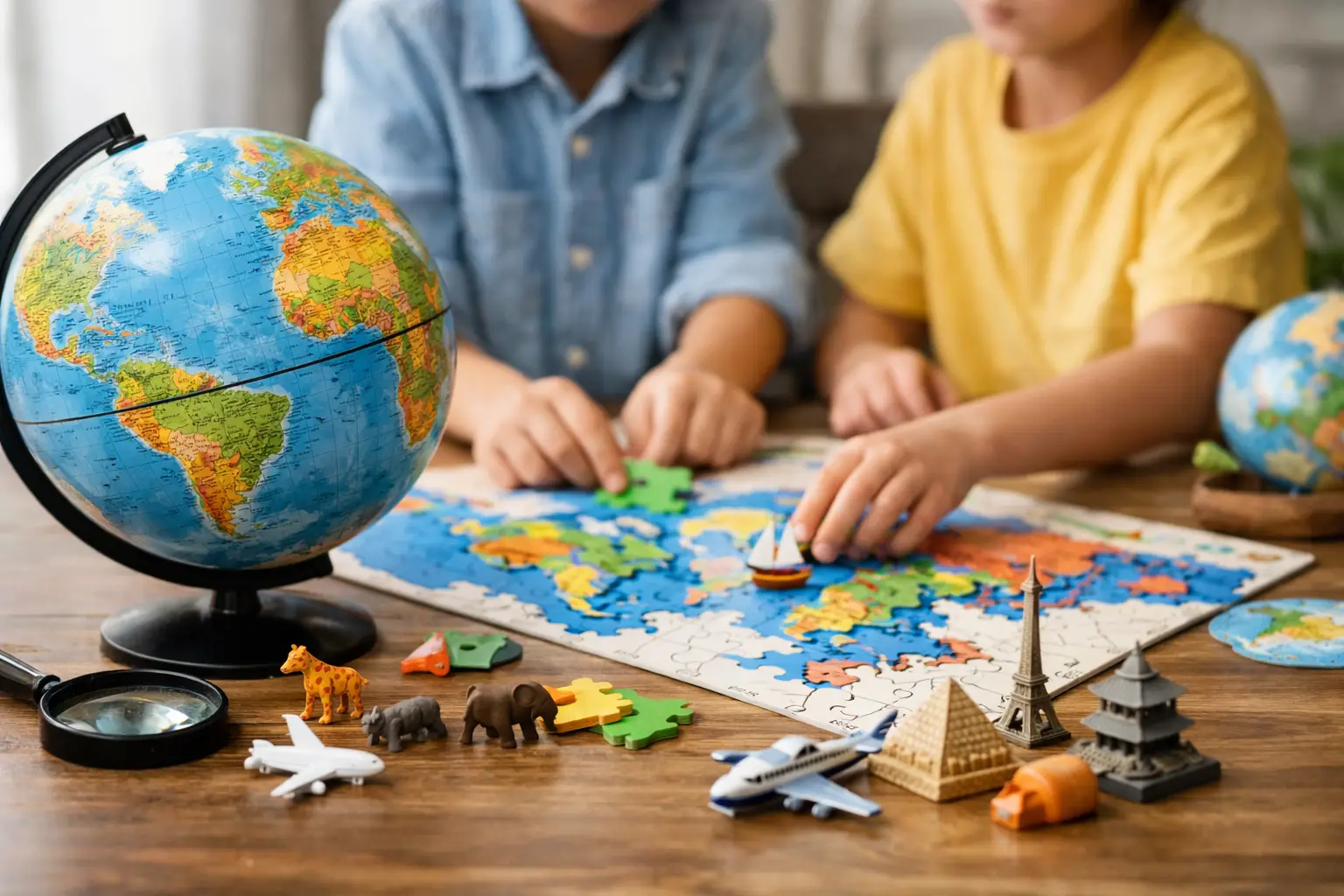
Ask someone to name every country in Africa on a blank map, and the room gets quiet fast. Ask them to guess a country from a partial flag, a capital clue, or a distance hint, and suddenly they want one more try. That gap matters. World geography education usually struggles not because the subject is boring, but because the format often is.
People rarely need more lectures about borders, capitals, and regions. They need a reason to care long enough for facts to stick. That is where play changes the equation. A good geography challenge does not water the subject down. It gives your brain a better way in.
Why world geography education often feels harder than it should
Geography has a branding problem. In school, it is often reduced to memorizing country names, labeling maps, and cramming for a quiz that is forgotten a week later. For plenty of adults, the memory of geography class is a stack of worksheets and a vague sense that they should know where Kyrgyzstan is.
The problem is not the content itself. World geography is packed with pattern, story, and surprise. Flags borrow symbols from history. Capitals reveal colonial legacies, trade routes, and political change. Borders show conflict, compromise, and geography in the physical sense - mountains, rivers, coastlines, deserts. But when learning is built around passive review instead of active recall, the information stays shallow.
That is why geography can feel weirdly slippery. You may recognize a flag when you see it, but struggle to name the country. You may know a capital once, then lose it by next month. Recognition is easy to confuse with mastery.
The real advantage of game-based world geography education
The best version of learning geography is not longer. It is more repeatable.
A short daily challenge works because it asks you to retrieve knowledge, not just look at it. That small difference matters. Retrieval forces the brain to work. If you see part of a flag and have to make a guess, you are pulling from memory, testing associations, and refining what you know. Even a wrong answer helps, because the correction lands harder after an attempt.
This is also why daily formats feel so effective. One big study session can be useful, but five minutes a day often beats an hour once a month. You get spaced repetition without turning learning into a chore. The pace is light, but the retention adds up.
There is another benefit that gets overlooked: games make uncertainty tolerable. In a classroom, getting a country wrong can feel embarrassing. In a game, it feels normal. You guess, adjust, and try again. That shift lowers friction, especially for beginners who like geography but do not want to feel tested every second.
What actually helps facts stick
If world geography education is going to work outside a textbook, it needs a few core ingredients.
First, it needs specificity. “Learn geography” is too broad to be motivating. “Guess today’s flag” or “name the capital in three tries” is concrete. People are more likely to start when the task is obvious.
Second, it needs repetition with variation. Repeating the exact same task can go stale, but repeating the same knowledge through different angles works well. A country can appear as a flag one day, a capital the next, and a distance clue after that. You are not just memorizing one fact. You are building a network.
Third, it helps to keep the stakes low and the feedback fast. If the result comes immediately, your brain connects the attempt to the answer. That tight loop is one reason quick geography games can teach more than slower study methods.
This is also where simple design matters. Free access, no signup wall, and a shared daily puzzle sound like product details, but they shape learning. If getting started takes ten seconds instead of ten minutes, people return more often. In education, convenience is not fluff. It is part of the system.
Geography is bigger than memorization
There is a fair criticism of some trivia-based learning: it can stay too shallow. If all you ever do is match flags to country names, you will improve at flags, but maybe not at geography as a whole.
That is true, up to a point. A single format has limits. Flag recognition is useful, but it is only one entry point. The stronger approach is a mix of modes that push different kinds of understanding. Capitals test political geography. Mystery-country clues teach comparative thinking. Distance and direction games build spatial awareness. Map-based prompts strengthen location memory. Together, they move learning from isolated facts to mental maps.
That “mental map” piece is the real prize. It is one thing to know that Nepal exists. It is another to know where it sits relative to India and China, what its terrain suggests, and why its location matters. Strong geography education builds context, not just recall.
Still, there is a trade-off. Faster, game-first formats usually prioritize accessibility over depth. That is not a flaw unless they pretend to do everything. A two-minute challenge is great at building familiarity and habit. It is not meant to replace a full lesson on migration patterns or geopolitical conflict. Used well, it becomes the front door, not the whole house.
Who benefits most from this approach
Students are the obvious fit, especially those who tune out when geography feels like pure memorization. A short challenge can turn review into something they actually choose to do.
Teachers can use game-style prompts as warm-ups, exit tickets, or quick resets between heavier lessons. The value is not just engagement. It is retrieval practice built into class time without needing a long setup.
Adults benefit too, maybe more than they expect. A lot of people want to be better at world knowledge but do not want another app demanding a streak, a subscription, and half their personal data. Lightweight daily geography works because it respects time. It feels productive without feeling like homework.
Trivia fans and travelers get a different kind of payoff. Geography helps you read the news better, understand sports tournaments faster, and make more sense of history, culture, and current events. Knowing where places are changes how global stories land. They stop sounding abstract.
Why shared daily challenges work so well
There is something underrated about everyone getting the same puzzle on the same day. It makes the experience social without making it complicated.
Shared challenges create a built-in reason to compare, talk, and come back tomorrow. That can sound minor, but learning sticks better when it has momentum. A daily puzzle gives knowledge a rhythm. You are not trying to overhaul your study habits. You are showing up for one fair, quick challenge and seeing how you do.
That social layer also adds accountability without pressure. If your friend gets today’s country in one guess and you need three, you remember it. Friendly competition sharpens attention. It makes a small fact feel worth noticing.
A platform like Flagdle works in that sweet spot because it keeps the barrier low and the loop clear. You show up, play, learn something, and move on. No account required. No complicated setup. That simplicity is not just convenient. It is what makes repeat learning realistic.
The best version of world geography education is built for return visits
If the goal is lasting knowledge, the format has to survive real life. Most people are not going to commit to long geography study sessions after school or work. They will, however, spend a few focused minutes on something smart and fun if it starts instantly and feels fair.
That is the bigger lesson here. World geography education improves when it stops acting like attention is unlimited. Short, repeatable, game-based learning meets people where they already are. It respects limited time, rewards curiosity, and makes progress visible.
And once that habit forms, deeper learning gets easier. A person who starts by guessing flags may end up caring about regions, languages, trade routes, and history. Interest rarely begins with a textbook chapter. More often, it starts with one good prompt and the urge to get the next answer right.
If geography has ever felt dry, that is not a sign the subject failed you. It may just mean the format did. Find one that makes you want another round, and the map gets a lot easier to keep in your head.