How to Study Capital Locations and Remember Them
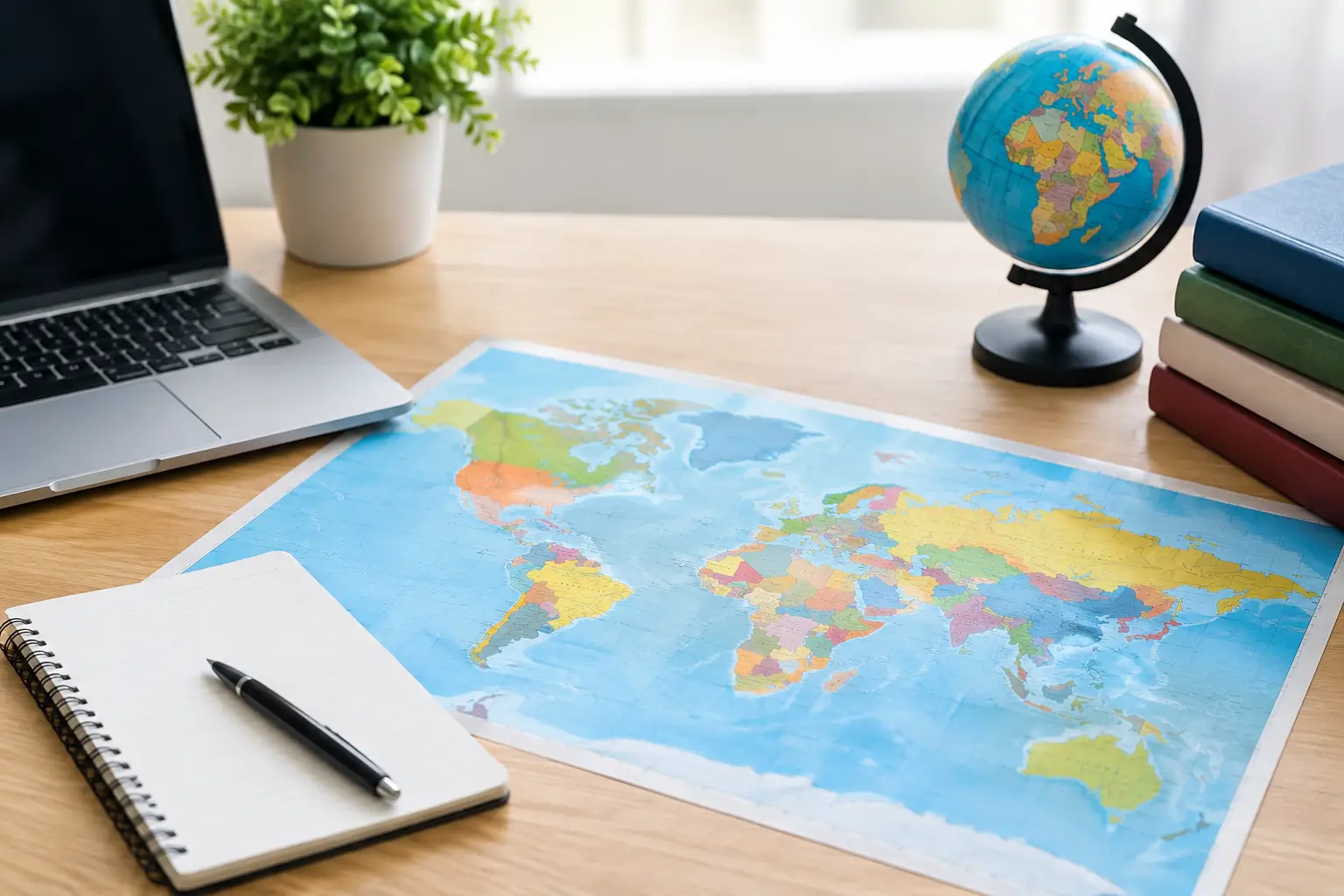
A capital name on its own is a trivia answer. Put it on a map, and it becomes a place with neighbors, coastlines, mountains, and a reason to be remembered. That is the key to how to study capital locations without staring at a giant map until every label turns into a blur.
The goal is not to memorize 195 disconnected country-capital pairs in one marathon session. The goal is to build a mental world map a little at a time, then test it often enough that the answer comes back quickly. A few focused minutes a day beats a long cram session almost every time.
Start With the Map, Not the List
A list can tell you that Mongolia's capital is Ulaanbaatar. It cannot show you that Mongolia sits between Russia and China, that it is landlocked, or that Ulaanbaatar is in the north-central part of the country. Those details give your brain hooks to hold onto.
Begin with a blank or lightly labeled world map. First, make sure you can place major regions: North America, Central America, South America, Europe, North Africa, Sub-Saharan Africa, the Middle East, Central Asia, South Asia, East Asia, Southeast Asia, and Oceania. Then work within one region at a time.
Do not worry about capitals yet if you cannot reliably point to the country. Country location comes first. Once you know where Chile runs along South America's western edge, Santiago has somewhere to live in your memory. Once you see that Laos is squeezed between Thailand, Vietnam, Cambodia, China, and Myanmar, Vientiane stops being a floating word.
Study Capital Locations in Small Clusters
The fastest way to overload your memory is to jump randomly from Canberra to Kigali to Bratislava. Instead, use clusters of nearby countries. Your brain naturally notices borders, shapes, and regional patterns.
Try a five-country cluster. For example, study the Baltic states plus nearby Finland and Poland. Place the countries first, then add Tallinn, Riga, Vilnius, Helsinki, and Warsaw. On the next round, hide the capital labels and name them from memory. On the round after that, hide both country and capital labels and rebuild the cluster.
This method works especially well in areas where countries are small or tightly packed, such as the Balkans, Central America, the Caribbean, and West Africa. These areas can feel intimidating because there is so much information in a small space. A cluster turns one hard map into a series of manageable neighborhood puzzles.
There is one trade-off: regional study can make you great at identifying nearby countries while leaving gaps elsewhere. Fix that by rotating regions. Spend a few days on one cluster, then revisit it after studying another part of the world.
Use Landmarks as Memory Anchors
A capital is easier to remember when it has a geographic clue attached. Look for coastlines, rivers, islands, mountain ranges, and borders.
Lisbon is on Portugal's Atlantic coast. Cairo sits beside the Nile. Budapest is split by the Danube. Tokyo is on Japan's eastern coast. Nairobi is inland, near the center-south of Kenya. Even when the clue is not perfectly precise, it gives you a useful direction.
For landlocked countries, use neighbors. Nepal's Kathmandu sits between the huge reference points of India and China. Paraguay's Asunción is inland in central South America, near Brazil and Argentina. Botswana's Gaborone is in the southeast, close to South Africa.
You are not trying to become a cartographer overnight. You are giving each capital a small story: country, region, nearby feature, approximate position. That is enough to make recall much more reliable.
Test Recall Before You Feel Ready
Recognition is sneaky. Looking at a map and thinking, “Yes, I know that,” feels productive. But tests and trivia games ask for recall: Can you produce the answer when the label is gone?
After studying a cluster for a few minutes, close the map. Name every country you remember. Then name each capital. Finally, sketch rough shapes or place dots on a blank map. Your drawing can be messy. The point is to expose what you know and what you only recognized.
When you miss one, do not just read the correct answer and move on. Return it to context. If you forget that Slovenia's capital is Ljubljana, locate Slovenia between Italy, Austria, Hungary, and Croatia. Notice how small it is. Then say the pair aloud: “Slovenia, Ljubljana, south of Austria.”
This extra ten seconds matters. A wrong answer corrected with context is more memorable than an answer you never had to retrieve.
Make Confusing Capitals Compete
Some capitals are difficult because they look or sound alike. Others are difficult because the country has a better-known city that is not the capital. Treat these as special matchups rather than hoping repetition will sort them out.
South Africa is a classic example: Pretoria is the executive capital, Cape Town hosts Parliament, and Bloemfontein is the judicial capital. Bolivia also has a split arrangement, with Sucre as the constitutional capital and La Paz as the seat of government. For everyday geography quizzes, check what convention the quiz uses, but learn the nuance rather than forcing a misleading single answer.
Then there are the surprises: Australia is Canberra, not Sydney; Turkey is Ankara, not Istanbul; Brazil is Brasília, not Rio de Janeiro; and Morocco's capital is Rabat, not Casablanca. Put these into a short “not the biggest city” review set. They are high-value questions because they appear often.
For similar names, create a contrast. Slovakia has Bratislava, while Slovenia has Ljubljana. Niger has Niamey, while Nigeria has Abuja. The comparison is the memory tool. Review the pair together until the distinction feels automatic.
Turn Practice Into a Daily Game
Geography rewards frequency. A seven-minute routine repeated for two weeks is more useful than a two-hour session you never repeat. Keep the loop simple: learn a small cluster, play a recall round, review misses, and return tomorrow.
Daily geography games are useful here because they create a reason to come back. A country clue, a capital prompt, or a map-based guess turns review into a quick challenge instead of homework. Flagdle can fit into that loop when you want a fast country and capital refresher without setting up an account.
Friendly competition can help, too. Send a friend five capital questions, compare scores, or take turns choosing a region. Keep it light. The best kind of competition gives you another excuse to retrieve answers, not another reason to avoid the map.
Use Spaced Review, Not Endless Repetition
If you learn a capital today, review it tomorrow. If you get it right, revisit it a few days later, then a week later. If you miss it, bring it back sooner. This is spaced repetition, and it works because the answer is slightly harder to retrieve each time.
You do not need a complicated system. Keep three simple groups: new capitals, shaky capitals, and solid capitals. New ones get reviewed daily. Shaky ones get reviewed every few days. Solid ones get a quick check once a week or whenever you play a mixed quiz.
A mixed quiz is essential. Region-by-region study builds the map, but random practice proves whether you can use it. If you only know Helsinki after seeing Sweden and Norway nearby, you have learned a pattern, not yet a durable answer.
Know What “Good Enough” Looks Like
There are different reasons to learn capital locations. A student preparing for a map quiz may need precise placement. A traveler may only need to recognize the capital and understand its region. A trivia player may prioritize quick country-capital recall over exact city dots.
Match the method to the goal. For exact placement, work from blank maps and compare your answer to the real location. For trivia, use fast prompts in both directions: “What is the capital of Ghana?” and “Accra is the capital of what country?” For broad world knowledge, focus on region, neighbors, and whether the capital is coastal, inland, northern, or southern.
The map will not stick because you tried harder once. It sticks when you keep returning to it, one small challenge at a time. Pick a region, place a few dots, miss a few answers, and come back tomorrow with a slightly sharper picture of the world.