How to Create Geography Study Rituals That Stick
A flag appears with its colors partly covered. You know you have seen it before, but the country name will not come. That small pause is where learning gets interesting. When you create geography study rituals instead of relying on occasional study marathons, those half-remembered flags, capitals, and map locations start becoming familiar.
Geography is not a subject that rewards one huge cram session very well. There are too many countries, borders, languages, cities, and visual patterns to hold onto at once. It works better as a daily habit: short, repeatable, and just challenging enough to make you think.
Why Geography Needs a Ritual, Not a Cram Session
A ritual is smaller than a study plan and easier to keep. It happens at roughly the same point in your day, has a clear start and finish, and does not require a perfect mood. Think five minutes with coffee, a quick puzzle after lunch, or a map question before bed.
The timing matters less than the cue. If geography comes after something you already do, such as opening your laptop or waiting for dinner to cook, it needs less willpower. Your brain starts to expect the challenge.
Daily geography also benefits from spacing. Seeing Indonesia on a map once may not be enough. Seeing it again two days later, then recognizing its flag next week, and then placing it near Papua New Guinea later on builds several paths back to the same answer. That is far more useful than rereading a list of capitals for an hour.
There is a trade-off: a tiny ritual will not prepare you for a major exam by itself. If you are studying for a class, use it as your daily foundation, then add focused review for the regions and terms your course covers. For most curious learners, though, a short ritual is exactly what turns geography from a fact pile into a skill.
How to Create Geography Study Rituals You Will Keep
Start by making the ritual almost too easy. A good first version might be one daily flag, one country on a blank map, and one fact you can say out loud. Five minutes is enough. The goal for week one is not to learn the whole world. It is to show up often enough that the routine feels normal.
Choose one anchor in your existing day. Morning works well if you like a quick mental win before messages and meetings. Midday can reset a tired brain. Evening is useful if you enjoy a calm screen break that is more satisfying than scrolling. Pick the time you are most likely to repeat, not the time that sounds most disciplined.
Give the session a finish line. “Study geography” is vague. “Solve today’s flag challenge, locate the answer, and review yesterday’s miss” is clear. You know when you are done, which makes it easier to begin tomorrow.
A daily Flagdle round can work as that starting signal: one shared challenge, three guesses, and a reason to notice colors, symbols, and regional design patterns. The game is the spark, not the entire routine. After your guess, take a few seconds to place that country in context.
Use recall before hints
The most valuable part of a geography ritual is trying to answer before you look. See a country outline and name it. Hear “capital of Mongolia” and give yourself a beat before checking. Look at a flag and notice the colors, shapes, and symbols before searching your memory.
Getting an answer wrong is not wasted time. It tells you exactly what needs another visit. A ritual that includes small, low-stakes mistakes is more effective than one built around only reviewing what already feels easy.
When you check an answer, add one connection. If the country is Laos, connect it to its neighbors, Thailand and Vietnam. If the answer is Chile, picture its long Pacific coastline and where it sits beside Argentina. If you miss the flag of Botswana, notice the light blue field and black stripe. Connections give a fact somewhere to live.
Rotate the type of challenge
Flags are memorable, but geography is bigger than flags. A simple weekly rotation keeps the habit fresh while letting different skills support each other. You might focus on flags on Monday, capitals on Tuesday, map placement on Wednesday, borders on Thursday, and a mixed quiz on Friday. On the weekend, revisit the questions that caught you out.
This does not need a complicated tracker. A note with three headings - “know,” “close,” and “review” - is enough. Put countries you recognize instantly in the first group. Put near-misses in the second. Put the answers that keep disappearing in the third.
Variety matters because recognition can fool you. You may recognize the name Suriname in a list but struggle to find it in South America. You may know that Canberra is Australia’s capital but hesitate when asked to distinguish it from Sydney. Switching formats tests whether the knowledge can travel.
Build a Small Review Loop
New questions are fun. Repeated questions are where memory gets stronger. Each ritual should include a little review, but it should not become a pile of old flashcards that makes you avoid the whole thing.
Keep the loop light. At the end of each session, choose one answer you missed or guessed. Bring it back tomorrow. Bring it back again a few days later. If it still feels uncertain, pair it with a visual detail, a neighboring country, or a quick story.
For example, do not just memorize that Bishkek is the capital of Kyrgyzstan. Picture Kyrgyzstan in Central Asia, west of China, and remember that its name has the repeated “k” sound. The connection does not have to be clever. It only has to give your memory a handle.
If you are using paper, write the question on one side and a clue on the other. If you prefer digital notes, keep a short running list of “countries to revisit.” Avoid recording everything. A review list should feel like a friendly rematch, not homework.
Add a map whenever possible
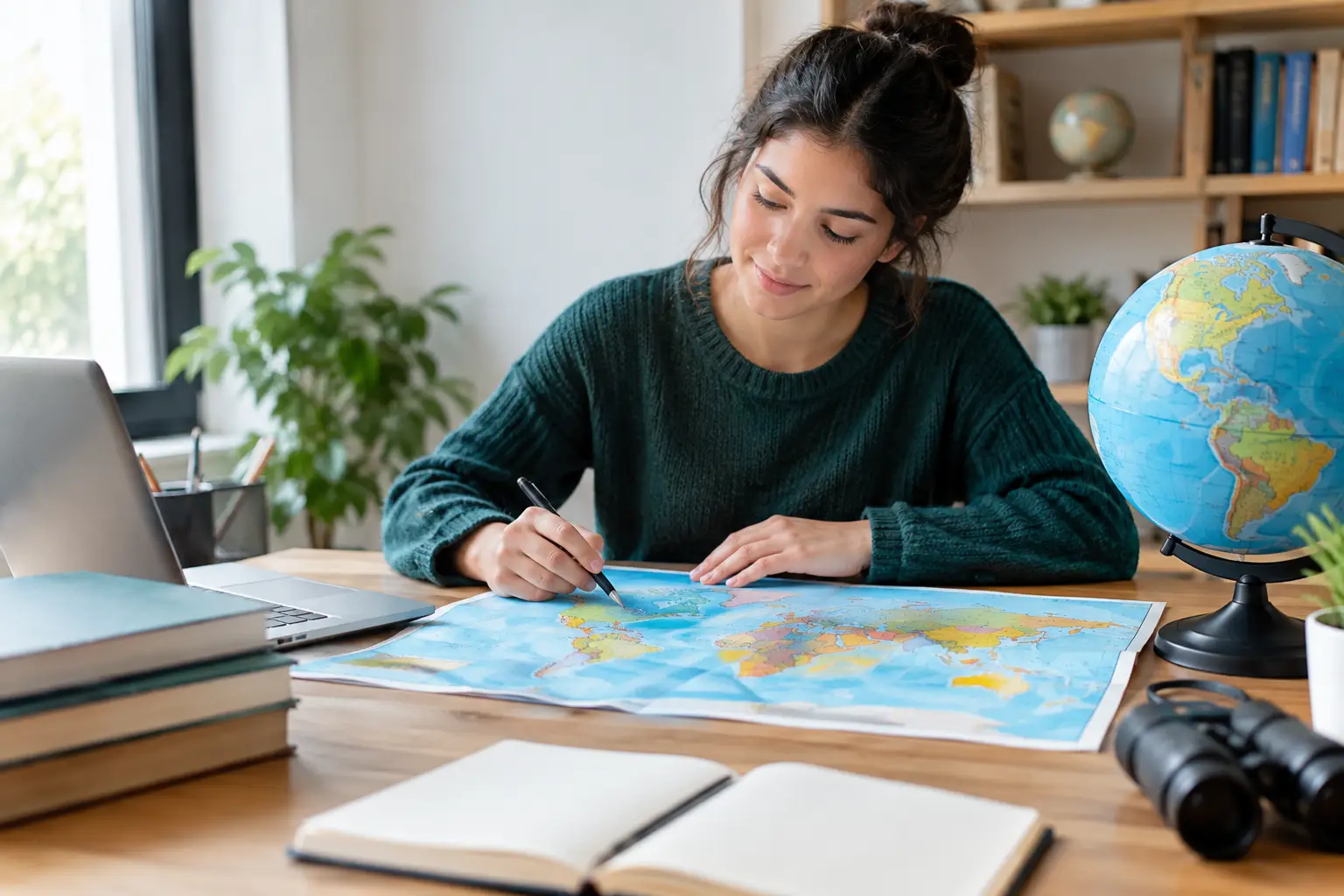
Country names float away when they are learned without location. A map gives them shape, neighbors, scale, and direction. After any flag or capital question, spend ten seconds asking: where is it?
You do not need to identify every border at first. Start with broad regions. Can you place it in West Africa, the Balkans, Central America, or Southeast Asia? Then narrow down. This progression makes unfamiliar countries less intimidating and helps you notice useful patterns, such as island nations, landlocked states, and long border chains.
A blank map is especially useful once or twice a week. Pick one region and label what you can from memory. Then check the answers without judging the gaps. Those gaps are your next few daily questions.
Make It Social Without Making It Stressful
Geography rituals are easier to maintain when they create a small conversation. Send a friend your score, ask a family member to name a flag, or compare which clue gave the answer away. Shared daily puzzles work because everyone is responding to the same prompt, but nobody needs to be an expert.
Keep the competition friendly. A fast answer is satisfying, but a thoughtful wrong guess can teach more. If someone gets a country you missed, ask what they noticed. Maybe it was a flag symbol, a direction clue, or a capital name pattern you had not seen before.
Teachers and parents can use the same idea with a low-pressure prompt: one country per day, one map location, one surprising fact. Let learners make guesses before revealing the answer. The goal is curiosity and repetition, not catching anyone out.
Protect the Ritual From Perfectionism
Missing a day does not erase progress. The mistake is treating one skipped session as proof that the routine failed. Just return with the next daily challenge. A good ritual is designed for real schedules, travel, exams, and days when your attention is elsewhere.
It also helps to keep your scope realistic. Learning every world capital at once may sound impressive, but learning the countries of one region well is more motivating. Start where you have a connection: places you want to visit, countries in a favorite sport, family history, or a region that appears in your classes.
As the habit grows, make it slightly harder. Move from recognizing flags to recalling countries from flag details. Move from placing broad regions to naming neighbors. Move from capitals to physical geography, languages, or independence history. Small difficulty increases keep the ritual interesting without turning it into a chore.
Tomorrow, do not promise yourself an hour of geography. Choose one daily challenge, one map check, and one answer to revisit. Five focused minutes is enough to make the world feel a little less distant.