Geography Wordle: Why It’s So Addictive
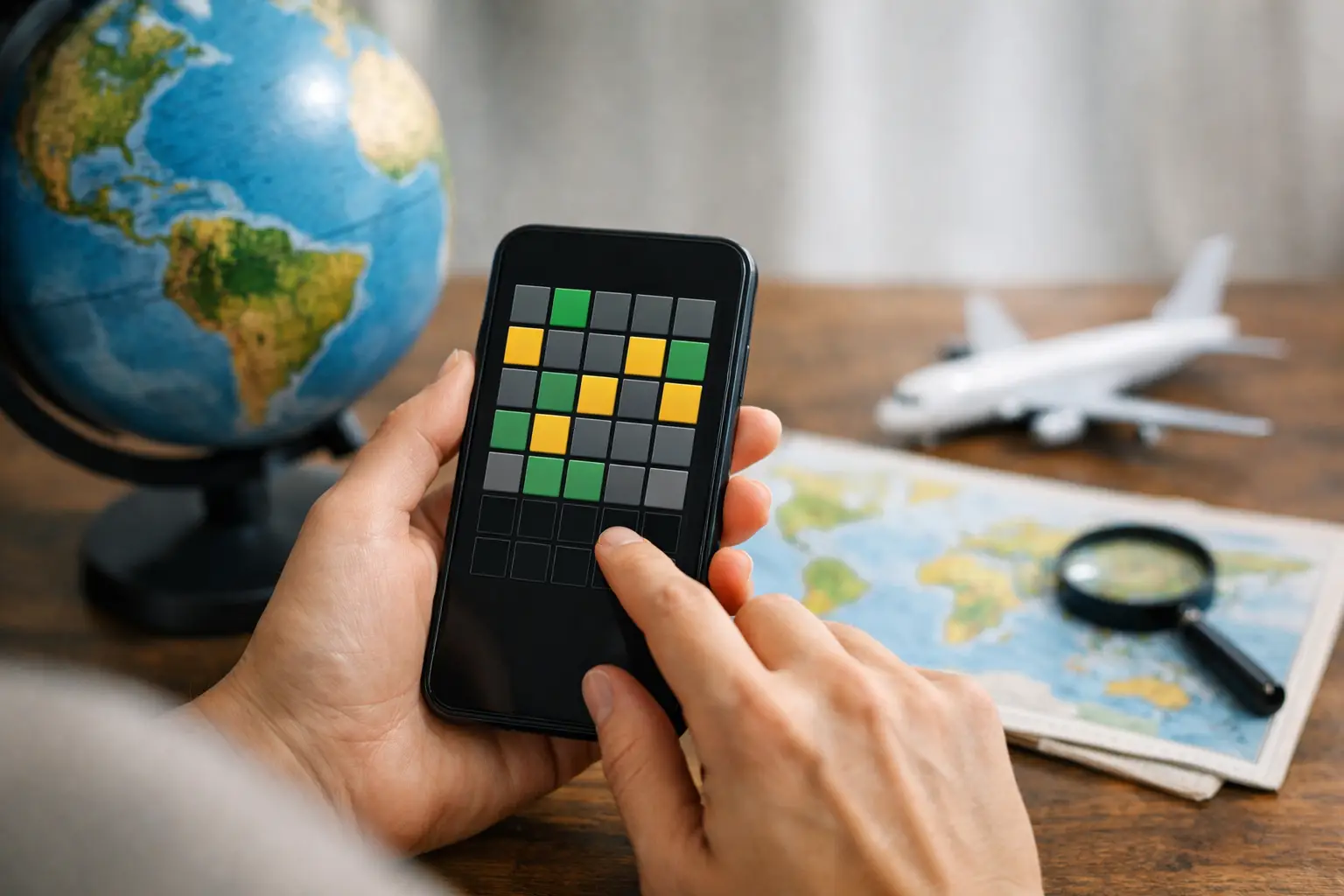
Miss one island nation in the South Pacific and suddenly your whole streak feels shaky. That is the charm of geography wordle. It looks like a quick daily puzzle, but a good round can test memory, pattern recognition, map sense, and a surprising amount of self-control.
That mix is why geography games have moved far beyond classroom drill territory. When the format borrows the daily puzzle rhythm people already know, geography becomes less about memorizing lists and more about making smart guesses under light pressure. One puzzle. A few clues. Everyone playing the same challenge. It is simple, but not shallow.
What geography wordle actually is
At its core, geography wordle is not one single game. It is a style of geography puzzle built around the same habit-forming idea that made daily word games stick: come back once a day, solve a shared challenge, compare results, and try again tomorrow.
Instead of guessing a five-letter word, you might identify a country from its flag, name a capital, use directional hints, or narrow down a mystery nation based on distance. The details change from game to game, but the appeal stays the same. You get a puzzle that is easy to start and hard to fake your way through.
That matters because geography is broad. Some players are strong with flags but weak with capitals. Others know Europe cold and get lost in the Caribbean or Central Asia. A geography wordle format works because it can turn all of those strengths and blind spots into game mechanics rather than homework.
Why geography wordle works so well as a daily game
The best daily games are fast to enter, fair to understand, and just difficult enough to make a win feel earned. Geography is a strong fit because the subject already comes with built-in variety. Countries have shapes, neighbors, flags, languages, capitals, coastlines, and regional patterns. Even a tiny clue set can feel rich.
There is also a nice balance between knowledge and deduction. If you instantly recognize Japan’s flag, great. If you do not, maybe you can still work backward from region, color patterns, or nearby countries. That makes the game more welcoming than pure trivia. It rewards what you know, but it often gives you a path when you do not know the answer right away.
The daily format helps too. A huge geography quiz can feel like a commitment. One puzzle feels light. You can play before class, between meetings, or while your coffee cools down. That low-friction routine is a big reason people keep coming back.
And then there is the social side. Shared daily puzzles are naturally compare-friendly. Not in a high-stakes, leaderboard-only way, but in a quick "how did you do today?" way. Geography is especially good for this because misses are funny, memorable, and sometimes humbling. Everyone has a region that exposes them.
The learning payoff is real, even when you are just playing
One reason geography wordle keeps spreading is that it feels productive without feeling heavy. You are playing a game, but your brain is quietly building a map.
Repeated exposure does a lot of the work. See the same country in different contexts and it starts to stick. Maybe one day you recognize Kenya by its flag. Another day you place Nairobi as the capital. Later, you use Tanzania and Uganda as neighboring clues. That layering is more effective than cramming because it creates multiple pathways to the same answer.
You also get better at relative geography, which is often more useful than perfect recall. Knowing that Laos is landlocked, that Uruguay sits between Brazil and Argentina, or that the Baltic states line up in a specific order helps across many puzzle formats. It is not just trivia storage. It is mental structure.
There is a trade-off, though. Fast daily games can favor recognition over deeper understanding. You may get very good at identifying flags without learning much about the countries behind them. That is not a flaw in the format so much as a reminder that different game modes teach different things. Flags sharpen visual memory. Capitals build recall. Distance and direction games strengthen spatial reasoning. The broader the mix, the better the learning.
Geography wordle is harder than it looks
A lot of players assume geography puzzles will be easy if they were decent at school maps. Then the game serves up a tiny flag detail, an unfamiliar capital, or a country they have not thought about in years.
That gap between familiarity and precision is exactly what makes the format compelling. Most people know more geography than they think, but less than they assume. The game lives in that space.
It also exposes common biases. Players from the US often know North America and Western Europe fairly well, then hit trouble in Africa, Oceania, or Central Asia. Travelers may do better with capitals and locations but miss flags. Students might recognize textbook countries and struggle with smaller island states. There is no single kind of geography intelligence, which keeps the game honest.
A good puzzle also makes you manage risk. Do you guess early because you are 80 percent sure? Or do you hold back and use another clue? That tiny decision loop gives geography wordle more tension than standard flashcard-style trivia.
How to get better without turning it into homework
Improvement usually comes from pattern spotting, not brute-force memorization. If you want to sharpen your geography game, start by noticing clusters instead of isolated facts.
Flags are a good example. Many countries share colors, stars, stripes, or similar layouts. Instead of trying to memorize every flag as a separate image, learn what makes close matches different. Romania and Chad, Monaco and Indonesia, Australia and New Zealand - those are classic traps. Once you learn the distinction, your accuracy jumps fast.
The same goes for capitals. Rather than drilling random pairs, connect capitals to regions and neighboring countries. If you know where the Balkans sit, or how West African countries line up, capital recall becomes less random and more logical.
Map-based hint games reward another skill: narrowing the field. If a clue tells you the target country is southeast of one guess and 1,000 miles away, you do not need perfect knowledge to improve. You need elimination. Start broad, then tighten.
If you enjoy variety, that is where a platform like Flagdle makes the habit stronger. Switching between flags, capitals, and mystery-country clues keeps the challenge fresh and rounds out your knowledge instead of training only one niche skill.
What separates a good geography game from a forgettable one
The strongest geography puzzle games do not overload the player. They keep the rules obvious, the feedback useful, and the barrier to entry close to zero.
That sounds basic, but it is the difference between a daily habit and a one-time visit. If a game needs a download, a sign-up, or a long tutorial, many players are gone before the first guess. Geography works best when the puzzle starts immediately.
Fairness matters too. Players should feel challenged, not tricked. A good geography wordle gives enough information to support deduction, even when the answer is obscure. If every round depends on a niche fact with no recovery path, the game becomes a filter for specialists instead of a fun test for everyone else.
Variety helps retention, but only when the core experience stays clean. Too many modes can feel scattered. Too few can feel repetitive. The sweet spot is a compact set of puzzle types that each train a different geography muscle while keeping the same quick, daily rhythm.
Why this format keeps growing
People want games that fit real life. Not two-hour commitments. Not endless menus. Just a smart challenge that starts fast and gives your brain something to do besides scroll.
Geography wordle fits that perfectly. It turns world knowledge into a repeatable, low-pressure habit. It feels social without demanding constant interaction. It feels educational without sounding educational. And it gives players a small daily win, or a small daily reality check, depending on how confidently they guessed Luxembourg.
That blend is hard to fake. When a geography game is free, instant, and good at teaching through repetition, it does more than entertain. It gives people a reason to come back tomorrow a little sharper than they were today.
The best way to enjoy it is also the simplest: play often, guess boldly, and let the misses teach you something you will recognize next time.