Teaching Country Capitals That Actually Stick
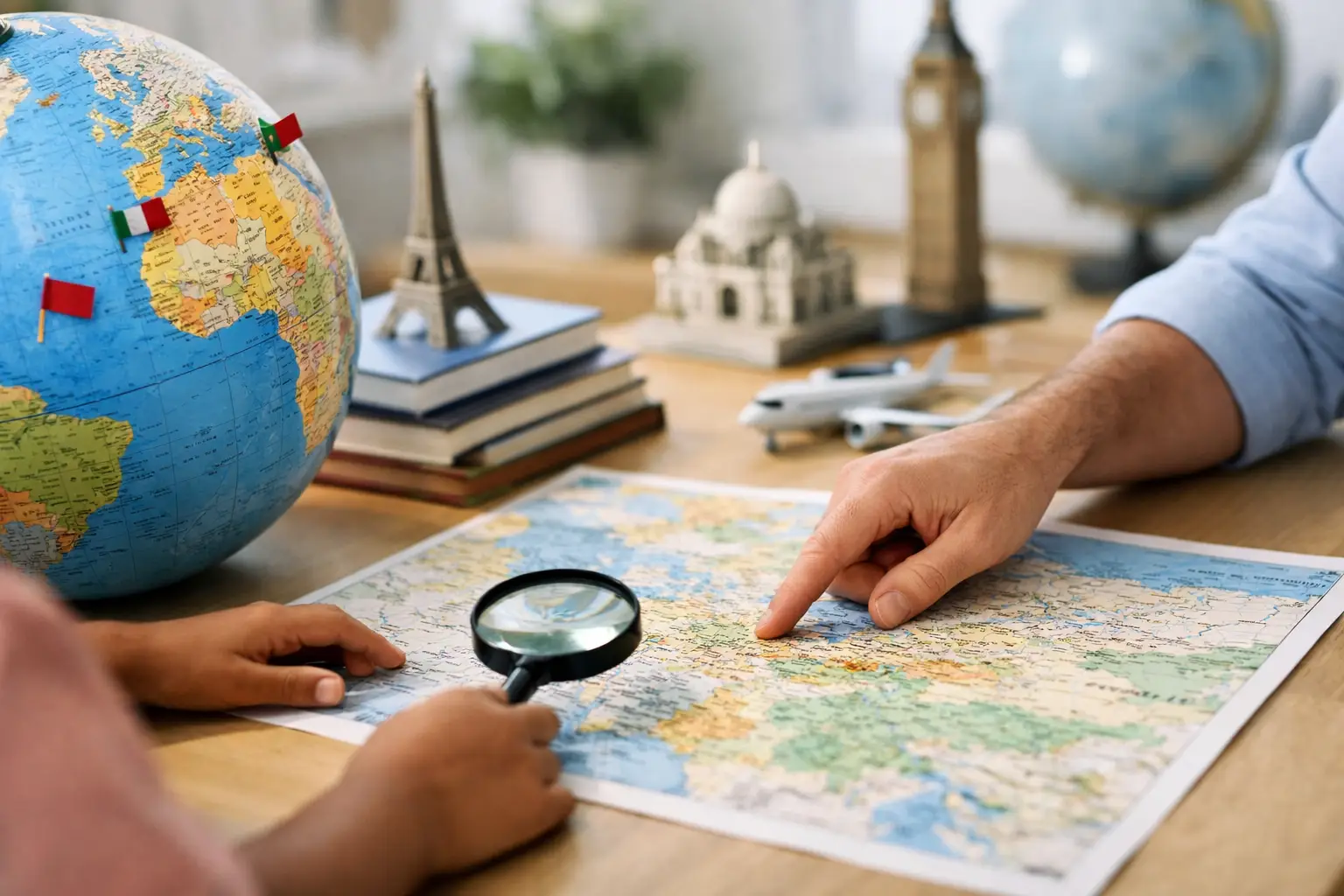
A student can point to Italy on a map, recognize the flag, and still blank on Rome five minutes later. That is the problem teaching country capitals needs to solve: not introducing a fact once, but helping learners pull it back out when it counts.
Capitals are often taught as a long list. The list gets memorized for Friday's quiz, then fades by Monday. A better approach makes every capital part of a larger mental picture: the country, its location, a clue, a comparison, and a quick chance to recall it again. Geography becomes less like cramming and more like collecting useful connections.
Why country capitals are harder than they look
A capital is an abstract pairing. There is no obvious visual reason that Canberra belongs with Australia or that Astana belongs with Kazakhstan. Some pairings feel familiar because they match the country name, such as Mexico City and Luxembourg. Others compete with a more famous city. Students may know Istanbul before Ankara, New York before Albany, or São Paulo before Brasília.
That does not mean memorization is useless. It means repetition needs context. When learners connect a capital to a map position, a flag, a neighboring country, or a memorable fact, they have more than one path back to the answer.
There is also a practical trade-off. Trying to teach every capital at once creates a large pile of similar-sounding names. Working in smaller groups can feel slower at first, but it produces better recall and less frustration. Start with a region, then mix old and new questions so students learn to tell countries apart rather than recite them in order.
Teaching country capitals with retrieval, not rereading
The fastest-looking study method is often rereading a chart. It is also deceptively passive. A learner sees “Japan - Tokyo” ten times and starts to mistake recognition for knowledge. Put the answer on the other side of the question, and the gap becomes clear.
Retrieval practice is simple: show the country and ask for the capital before revealing it. Better still, alternate the direction. Ask “What is the capital of Peru?” and later “Lima is the capital of which country?” The reverse question matters because it prevents students from relying on one fixed sequence.
Keep the rounds short. Ten questions are enough for a warm-up, a transition between activities, or the last five minutes of class. The goal is frequent recall, not a single exhausting session. If a student misses an answer, give the correction immediately, then bring that same pair back a few questions later. A correct answer after a miss is where learning starts to stick.
Use spacing to make the memory last
A capital recalled once is not learned forever. Revisit it after a few minutes, then a day, then several days later. This is called spaced practice, but it does not need a complicated schedule.
For example, introduce five South American capitals on Monday. On Tuesday, begin with those five before adding another five. On Thursday, mix all ten with a few capitals from an earlier unit. The growing mix creates productive difficulty. Learners must search their memory instead of following the order in which they first saw the answers.
Daily geography games fit this pattern well because they ask for a small amount of attention repeatedly. A quick capitals challenge can become a low-pressure check-in: one question, one guess, one new connection. Flagdle-style daily play also gives friends or classmates a shared prompt without requiring a long study block.
Put capitals on the map
Maps turn a name pair into a location story. Instead of teaching “Kenya - Nairobi” as a standalone fact, show Nairobi in relation to the equator, the Indian Ocean, and neighboring Uganda and Tanzania. The learner does not need to become a cartographer. They just need enough spatial context to make the answer feel attached to a real place.
Use blank maps after learners have had time with labeled ones. Ask them to place a dot or write a capital in roughly the right area. Accuracy matters, but rough placement is valuable too. Knowing that Wellington is in the lower part of New Zealand, rather than somewhere in Europe, is a meaningful step.
A useful classroom or home routine is to pair three prompts together: identify the country, locate it on a map, and name its capital. Change the starting point each time. Show a flag and ask for the country and capital. Show a capital and ask for the country and region. Show a map outline and ask for both names. The variety makes knowledge more flexible.
Use flags and clues carefully
Flags are great memory hooks because color and shape are easier to notice than text on a list. A student who remembers the cedar on Lebanon's flag may find it easier to retrieve Beirut. But the flag should support the capital, not replace it. If learners can ace a flag quiz but cannot name a capital, add a second question before the round ends.
Clues can work the same way. “This capital sits on the Danube” may help prompt Budapest. “This country has a maple leaf on its flag” can cue Canada, then Ottawa. Keep clues short and specific. Too many details turn a quick recall game into a reading-comprehension task.
Be cautious with simplistic associations, especially cultural ones. A memorable clue should be accurate, respectful, and useful. It is better to connect a capital to geography or a distinctive landmark than to reduce a country to a stereotype.
Make the tricky capitals visible
Some errors are predictable, so teach them openly. Australia has Canberra, not Sydney. Turkey has Ankara, not Istanbul. Switzerland's capital is Bern, not Zurich or Geneva. Brazil has Brasília, not Rio de Janeiro. These are not failures of intelligence. They are examples of a familiar city crowding out the capital.
Create a “popular but not the capital” round whenever a region produces repeat mistakes. Present the famous city first, then ask for the actual capital. The surprise creates a useful contrast. Students are more likely to remember Canberra when they have actively corrected Sydney.
Pronunciation deserves room too. If a learner is unsure how to say a place name, they may avoid answering even when they know it. Say names aloud, invite approximations, and correct kindly. Geography knowledge should feel like an open door, not a test of who has heard the most travel documentaries.
Turn practice into a game without losing the learning
A game works when the rule is clear and the feedback arrives fast. For capitals, that can be as simple as a timed five-question round, a map race, or a daily puzzle where each clue narrows the possible country.
Competition can motivate some learners, but it is not the only option. Team play lets students talk through clues. Personal streaks reward consistency. A class goal, such as reaching 80 percent correct on a mixed set, encourages improvement without putting every wrong answer on display.
The best game format depends on the group. Younger learners may enjoy matching cards and visual clues. Trivia fans may prefer fewer hints and harder distractors. Travelers might want practical regional sets before a trip. Keep the challenge just beyond automatic recall, then adjust. If everyone gets every answer instantly, add reverse questions or map placement. If scores collapse, reduce the set and offer stronger clues.
Build a routine people will return to
Country capitals become familiar through contact, not marathon sessions. A three-minute daily habit beats a two-hour cram session that never happens again. Put one capital question at the start of a lesson, during breakfast, or before a group chat winds down. The smaller the barrier, the more likely the routine survives.
Track improvement in a simple way: a growing streak, fewer repeat misses, or a region completed with confidence. Avoid treating one score as a verdict. Someone who misses Kigali today may retrieve it tomorrow, and that second attempt is the win worth noticing.
The next time a capital slips away, do not add it to a bigger list. Put it on a map, say it aloud, connect it to one clear clue, and ask again tomorrow. That is how a hard-to-hold fact becomes part of the world a learner can actually see.