Country Puzzle Platforms That Make Geography Stick
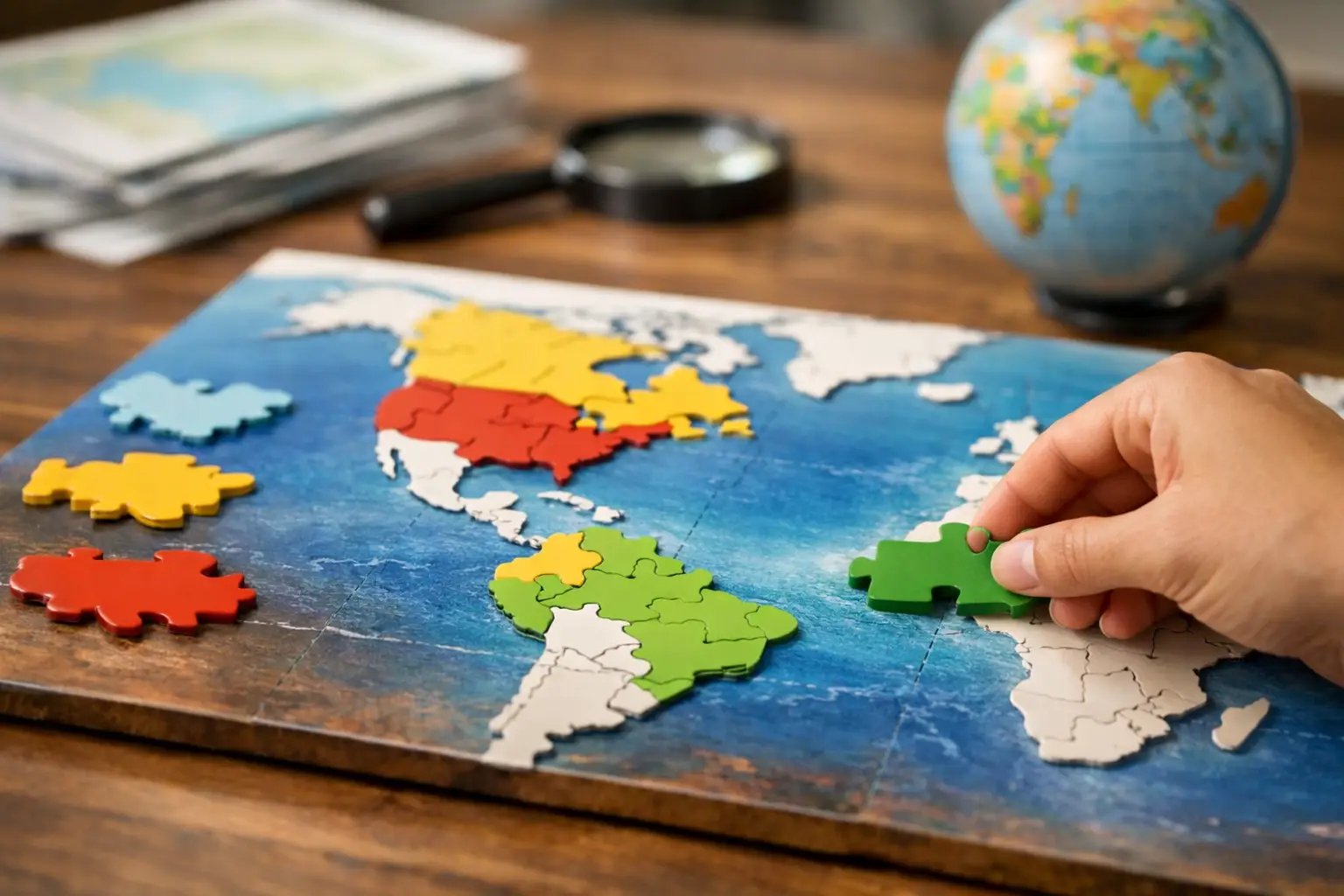
A flag appears with most of its design hidden. You have three guesses. That tiny moment asks more of your brain than a scroll through a map ever could: notice the colors, recall a region, separate a familiar pattern from a near match, then commit to an answer.
That is the appeal of country puzzle platforms. They turn geography from a subject people think they should know into a quick challenge they want to play. The best versions do not feel like homework, yet they leave players better able to recognize countries, capitals, borders, and the visual clues that connect them.
Why country puzzle platforms work
Geography is full of facts, but facts alone are easy to forget. A country name on a study sheet has no pressure, no context, and usually no reason to return tomorrow. A short game changes the equation. It gives the player a clear goal, limited information, and immediate feedback.
That feedback matters. If a guess is wrong, it is not just a missed answer. It becomes a clue. Maybe the mystery country is farther east. Maybe its capital is warmer than expected, or its flag shares a color scheme with several neighbors. The player starts building connections rather than memorizing isolated entries.
Daily formats add another useful layer: repetition without overload. One puzzle takes only a few minutes, which makes it easy to fit between classes, on a lunch break, or before bed. Over weeks, those small sessions create repeated exposure to the world map. A player who cannot place Kyrgyzstan on day one may recognize its flag, neighboring countries, or capital clues a month later.
The shared daily puzzle also makes learning social. When everyone gets the same challenge, scores become something to compare without turning the experience into a high-stakes competition. A friend can say, “I got it in two,” and suddenly a country that might have been overlooked becomes part of a conversation.
What separates a good country puzzle platform from a forgettable one
A geography game can be colorful and still teach very little. The strongest platforms make smart choices about friction, fairness, and variety.
The rules should be clear in seconds
Players should know what they are trying to identify and what a guess will tell them. If a game needs a long tutorial, a complicated scoring system, or several screens before the first puzzle, it loses the advantage of being a quick break.
Simple does not mean shallow. A partially covered flag can lead to surprisingly close calls. Distance and direction clues can turn a country guess into a logic puzzle. Capital prompts can test a different kind of recall. The mechanic should be easy to enter while leaving room to improve.
Clues need to reward reasoning, not random luck
Good clues narrow the field in a way players can understand. If the answer is thousands of miles away, that should mean something. If an arrow points northwest, players should be able to use it to form a better next guess.
Fairness also means recognizing that geography knowledge is uneven. Someone may know European capitals well and struggle with island nations in the Pacific. A platform that offers multiple modes gives players more than one way to learn. Flags build visual recognition. Capitals strengthen recall. Mystery-country hints encourage deduction. Distance games make the map feel spatial instead of abstract.
A daily challenge needs a reason to return
Fresh content is the basic requirement, but variety keeps a streak from becoming a chore. Repeating the exact same task every day can flatten the fun, even when the answers change. Rotating between flags, capitals, country facts, and map-based clues keeps players practicing different skills.
The best pacing is short enough to finish quickly and interesting enough to replay tomorrow. There is a trade-off here. A platform with endless games may suit someone studying for a geography quiz, while a single shared challenge is better for players who want a simple daily ritual. Neither format is automatically better. It depends on whether the goal is focused practice, relaxed entertainment, or a little of both.
Access should not get in the way
For a two-minute puzzle, forcing a download, account creation, or complicated setup can feel out of proportion. Browser-based games have a real advantage because the game can start when curiosity strikes.
Free, no-account-required play is also a practical choice for classrooms, families, and casual players. A teacher can put a puzzle on a screen without asking students to hand over personal information. Friends can share a challenge without needing to join the same app. The game stays centered on the country, not the sign-up flow.
The learning is in the guessing
The educational value of country puzzles is not limited to getting the final answer right. It comes from the path between guesses.
Consider a player trying to identify a hidden flag. They may first notice red, white, and blue and guess the Netherlands. A clue or reveal shows that the answer was Serbia. Next time, the player may remember the coat of arms, stripe order, or regional context that separates them. That small correction is more memorable than being told to study a chart of flags.
This is active recall: pulling information from memory instead of simply seeing it again. It is one reason a wrong guess can still be productive. The key is quick, useful feedback. After the puzzle, players should be able to see the answer clearly and leave with one detail worth remembering, whether that is a flag pattern, a capital, a neighboring country, or a location on the map.
Country puzzles can also challenge assumptions. People often know places through headlines, sports teams, travel photos, or broad regional labels. Games create opportunities to fill in the gaps. Where exactly is Suriname? Which countries use Portuguese? Why do several flags share Pan-African colors? The next question grows naturally from the last answer.
A better way to build a geography habit
The most sustainable geography practice is not an ambitious plan that lasts three days. It is a small routine that feels easy to repeat. Play one daily puzzle, make your first guess without searching, and take a few extra seconds to look at what the clues taught you. That is enough to build momentum.
If you want a little more structure, vary the skill you practice across the week. Use flags to sharpen visual memory, capitals to test direct recall, and distance clues to improve map sense. When a country appears more than once, try to connect the modes. Recognizing Belize’s flag is useful. Remembering that Belmopan is its capital and that the country sits on Central America’s Caribbean coast makes the knowledge stick.
Sharing results can help, too, as long as it stays friendly. Comparing guesses is fun because it reveals different ways people reason. One player may spot a flag detail immediately. Another may solve it from geographic direction. Both are learning how to approach the same world from different angles.
Country puzzle platforms are strongest when they respect your time
A good geography game does not need to demand an hour to teach something real. It needs a fair challenge, a useful clue, and a reason to come back. That is why a compact set of daily modes can be more valuable than a giant database of facts no one wants to open.
Flagdle follows that idea with daily flag guessing alongside country, capital, distance, and quiz-style challenges. The point is not to turn every player into a cartographer overnight. It is to make the next country feel a little less unfamiliar than the last.
Try one puzzle when you have a spare minute. Make the guess before you second-guess yourself. Then carry one new place, flag, or fact into the rest of your day.