Daily Geography Puzzle Review for Curious Minds
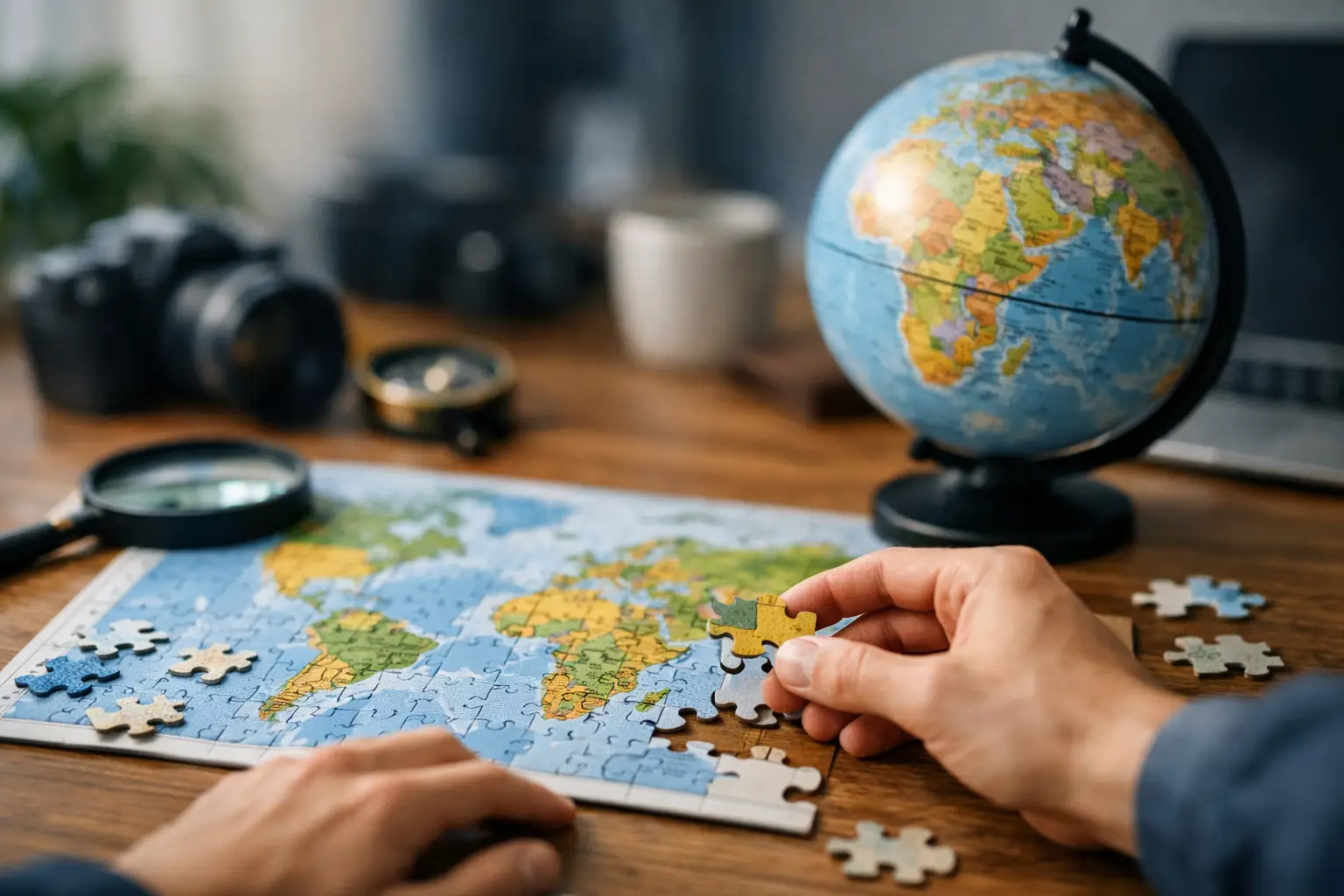
A map quiz can feel like homework. A good daily geography game feels more like spotting a familiar place from an airplane window: quick, satisfying, and just challenging enough to make you look twice. This daily geography puzzle review looks at why the format works, what separates a fair puzzle from a frustrating one, and whether a few minutes of play can actually improve how you see the world.
What a daily geography puzzle gets right
The best daily puzzles give every player the same challenge. That simple rule changes the experience. You are not grinding through an endless feed of random questions or trying to beat someone with more free time. You get one country, one flag, one capital, or one set of clues, then compare your result with friends.
That shared structure also makes geography more memorable. When everyone is trying to identify the same partially hidden flag, the answer becomes a small event. You might remember it because you solved it in one guess, missed an obvious color pattern, or finally learned where a country sits on the map. The knowledge has a moment attached to it.
The daily format is especially good for people who enjoy Wordle-style games but want a challenge that reaches beyond vocabulary. A flag can teach visual recognition. A capital clue can test recall. A distance-and-direction guess can turn the globe into a spatial puzzle. Each mode uses a different part of your geography knowledge.
Daily geography puzzle review: the core test
A geography puzzle does not need complicated rules. In fact, it usually works better when the goal is clear in seconds. See the prompt, make a guess, get useful feedback, and learn something whether you win or lose.
That last part matters. A puzzle that only says “wrong” is not very educational. Better games give feedback that helps players form a stronger mental map. If a mystery-country game tells you your guess is north, south, east, or west of the answer, your next try becomes a real reasoning step. If a flag game gradually reveals more of the image, the puzzle rewards observation rather than blind luck.
Three guesses is a strong limit for a flag challenge. It creates pressure without turning a quick game into a long test. There is room to recover from an early miss, but not enough room to click through every country you can name. The result feels fair when the clues are readable and the answer is recognizable from what the game reveals.
A good puzzle should also respect different skill levels. Someone who knows every national flag wants a clean test of recall. Someone who is still learning should leave with a new association, not the feeling that geography is only for experts. That balance is hard to get right, but it is what makes a daily game worth returning to.
Why flags make such a strong first challenge
Flags are compact visual clues. Color, shape, symbols, stripes, stars, and emblems can all point toward an answer. At first, many flags blur together. Over time, players begin noticing the details: a different shade, an unusual triangle, a centered symbol, or a pattern that only appears in one place.
This is useful learning because it builds recognition rather than forcing memorization from a list. You see a clue, make a connection, and test it immediately. A wrong guess can be productive too. If you confuse two similar flags, that contrast is often what helps both stick next time.
There is a trade-off, though. Some flags are naturally harder than others, especially when the image is partially covered. A fair game needs a reveal system that gives players enough information before the final guess. Difficulty should come from the country itself, not from a clue that is too tiny, cropped, or unclear to read.
That is why a flag puzzle works best as part of a broader geography routine. Flags sharpen visual memory, but they do not always teach location, language, borders, or capitals on their own. Pairing them with other game types creates a fuller picture.
More than a flag game
The most useful geography platforms make room for different ways to think. Capital games ask for direct recall. Mystery-country challenges turn facts into deduction. Distance-and-direction modes ask you to imagine where places sit relative to one another. Quizzes can slow things down and add context when you want more than a single round.
This variety matters because geography is not one skill. You may recognize the flag of Laos but struggle to place it near Thailand and Vietnam. You may know that Canberra is Australia’s capital yet miss a map-based clue about the country’s southern hemisphere location. Switching formats exposes those gaps without making the experience feel like studying.
Flagdle is built around this idea. Its daily flag game is fast enough for a coffee break, while its additional country, capital, quiz, and map-focused modes give regular players a reason to keep learning after the day’s flag is solved. The appeal is not having more games for the sake of it. It is seeing the same world knowledge from different angles.
Is daily play enough to build real knowledge?
It depends on what you mean by “enough.” Five minutes a day will not turn anyone into a cartographer overnight. It can, however, make geography familiar in a way that occasional cramming rarely does. Repeated exposure is powerful. Countries that once felt like names on a long list begin to have flags, neighbors, capitals, and visual identities.
Daily play works because it is small. There is no setup, no account to create, and no pressure to finish a giant lesson. You can make one guess while waiting for class to start, during a break at work, or before opening your usual daily puzzle. That low barrier makes the habit more likely to last.
The strongest learning happens when you give yourself an extra ten seconds after a round. If you miss the answer, ask what clue you overlooked. Was it a flag feature? A regional pattern? A capital you mixed up with another city? That brief reflection turns a result screen into a memory cue.
For students, daily puzzles can support classroom learning without feeling like another assignment. For teachers, they can be a quick warm-up or a conversation starter. For travelers and trivia fans, they offer a playful way to keep country knowledge active between bigger adventures and pub-quiz nights.
What can make the format less fun
Not every daily puzzle earns a daily visit. The biggest problem is friction. If a game asks for a download, a sign-up, a long tutorial, or too much personal information before the first guess, the quick-play promise disappears. Geography games are at their best when you can open a browser and start thinking immediately.
Repetition can also hurt. A game that uses only one clue type may become predictable, even if the answers change. Variety helps, but it should not come at the cost of clarity. Players should always know what they are being asked to do and what a correct answer means.
Then there is difficulty. An easy streak can feel flat, while a run of obscure answers can make players feel shut out. The sweet spot is a mix of familiar countries, close calls, and occasional surprises. A challenging answer is welcome when the game gives enough feedback to make the lesson stick.
How to get more from each round
Treat your first guess as a reasoned guess, not just the first country that comes to mind. In a flag game, look for the arrangement before the colors. Horizontal stripes, vertical stripes, a cross, a triangle, or a central emblem can narrow the field quickly. Then check the details that separate similar designs.
In map-based games, think region before country. If feedback tells you the answer is east of your guess, do not jump across the world unless the other clues support it. Build a rough mental route from your first answer to the next one. That is how direction feedback becomes geography practice instead of a guessing shortcut.
It also helps to share your score after you play. Friendly comparison adds a little energy, but it can reveal how differently people solve the same clue. One friend may spot a color pattern immediately. Another may remember a capital or a neighboring country. Those conversations are part of what makes a shared daily puzzle feel bigger than a solo screen.
A daily geography game is not meant to replace an atlas, a class, or a real trip. It is a small prompt to stay curious. Make your guess, notice the clue you missed, and come back tomorrow knowing one more piece of the map.