Country Quiz vs Capital Quiz for Daily Play
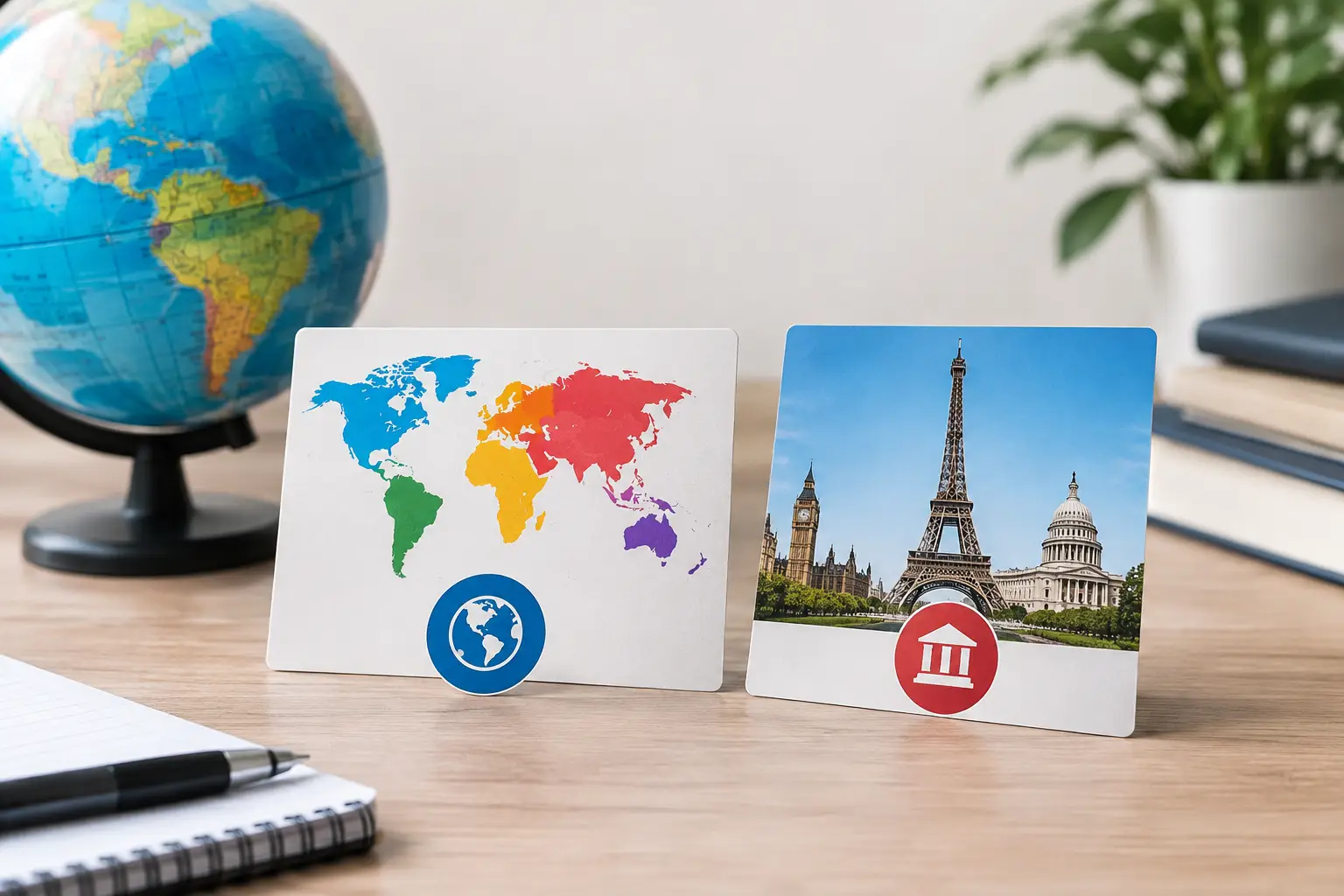
A country quiz vs capital quiz can feel like the same geography challenge until the first question trips you up. Recognizing Italy on a map is one skill. Pulling Rome from memory, without a map or a clue, is another. Both are quick, satisfying ways to learn the world, but they test different parts of your geography brain.
If you want a daily game that feels fun instead of like homework, the better choice depends on what you already know, what you want to improve, and how you like to solve a puzzle.
Country Quiz vs Capital Quiz: What Changes?
A country quiz asks you to identify the place itself. You might see an outline, a flag, a neighboring country, a landmark, or a few clues about language, location, or history. The goal is to connect information to a place on the globe.
A capital quiz flips that relationship. You get the country and need to name its political center, or you see a capital and identify the country. It sounds simple, but capitals often require more direct recall. There is less visual support, especially when the answer is a city name you do not hear often.
That difference matters. Country quizzes build spatial awareness. They help you understand where places are, what borders they share, and how regions fit together. Capital quizzes strengthen country-city connections and expose the gaps hiding behind familiar map knowledge.
Neither format is automatically harder. A map-based country question can be tough when the outline is small, island nations look similar, or borders are unfamiliar. A capital question can be easy when the answer is Paris, Tokyo, or Mexico City. Difficulty depends on the question design and your starting point.
Choose a Country Quiz When You Want Context
Country quizzes are usually the more welcoming entry point for newer geography players. Even when you do not know the answer immediately, the question may give you something to work with. The shape of a coastline, the colors of a flag, or a nearby country can trigger a useful guess.
That makes country play feel more like solving a puzzle than reciting a fact. You can use deduction: a long, narrow shape may point to Chile; a cluster of islands may narrow the field; a flag's symbols can hint at a region. Wrong answers still teach you something because you can compare locations and patterns.
This is especially useful for students, travelers, and anyone who wants a stronger mental map of the world. Knowing that Hungary sits in Central Europe or that Senegal lies on Africa's western coast gives future questions more context. Capitals become easier once countries stop floating around as isolated names.
Country quizzes also offer more variety. Flags, map outlines, direction clues, neighboring nations, and mystery hints can all lead to the same answer. That keeps a daily challenge fresh while reinforcing the same core skill: recognizing countries.
Best for visual learners and puzzle fans
If you remember images better than lists, start here. Flags and maps give your memory something concrete to hold onto. A country quiz is also a strong fit for people who enjoy Wordle-style logic, where each guess reveals a little more about the answer.
The trade-off is that visual recognition can sometimes create false confidence. You may spot a country on a map but still struggle to name its capital, language, currency, or major cities. Country knowledge is a strong foundation, not the entire game.
Choose a Capital Quiz When You Want Recall Practice
Capital quizzes are direct. There is no coastline to inspect and no flag colors to lean on. You either retrieve the country-capital pair or you do not, which can make a correct answer feel especially rewarding.
That directness is why capital quizzes are great for building durable recall. Repeatedly connecting Kenya to Nairobi or Kazakhstan to Astana helps turn a fact from "I have seen that before" into "I know it." For school prep, trivia nights, and personal goals, that matters.
Capital questions also reveal a useful truth: famous countries do not always have the capitals people expect. Many players know the largest city but miss the official capital. Australia is not Sydney, Turkey is not Istanbul, and Brazil is not Rio de Janeiro. Those surprises are exactly where learning sticks.
Best for trivia players and fact collectors
Choose a capital quiz if you like clean questions with clear wins. It is ideal when you have five minutes and want to test yourself without interpreting a map or a clue. You can also track progress easily: every country-capital pair is a specific fact to learn.
The downside is frustration. If a quiz serves a run of less familiar countries, it can feel like a wall of names. That is normal, not a sign that you are bad at geography. Use misses as a short study list, then come back later. The second correct answer is usually more satisfying than the first.
Which Quiz Helps You Learn More?
The honest answer is both, especially when you alternate them. Country quizzes give facts a location. Capital quizzes give those locations a name worth remembering. Together, they build a connected picture instead of a pile of disconnected answers.
Think of geography as a set of links. First, you recognize a country. Then you place it near other countries. Next, you connect its capital, flag, landmarks, and region. Each format strengthens a different link. Skipping one can leave your knowledge uneven.
If you are starting from scratch, country questions often provide the smoother path. Learn the map first, then layer capitals onto it. If you already know most flags and can locate major countries quickly, capital quizzes are a better way to add challenge.
There is also a practical difference in how mistakes teach. Missing a country question may lead you to compare shapes, borders, and regions. Missing a capital question often calls for repetition. One trains deduction; the other trains retrieval. A balanced geography habit needs both.
A Simple Daily Geography Routine
You do not need an hour or a giant study guide. A short, repeatable routine works better for most people. Start with one country-based challenge to warm up your visual and spatial memory. Follow it with a few capital questions that cover the same region.
For example, if you identify countries in South America, try naming their capitals next. If you miss one, say the pair aloud once or twice and picture the country on the map. That tiny extra step creates a stronger connection than simply reading the correct answer and moving on.
Keep the challenge level slightly uncomfortable. If every question is easy, you are mostly confirming what you know. If every question is impossible, you will stop playing. Mix familiar countries with less common ones, and let patterns build over time.
A daily game helps because repetition arrives in small doses. Flagdle can make that habit easy with quick geography challenges that ask you to notice, guess, and learn without an account or a long setup.
The Best Choice Depends on the Moment
Play a country quiz when you want clues, images, and map-based problem-solving. Play a capital quiz when you want a sharper memory test and a fast round of trivia. On a low-energy day, country questions may feel more approachable. When you want to prove how much you know, capitals can provide the better test.
The most useful rule is simple: do not avoid the format that exposes your weak spot. If capitals keep catching you, that is where the next bit of progress lives. If map shapes blur together, keep guessing countries until the world starts to look less like a quiz and more like a place you recognize.
Tomorrow, try the version you usually skip. One good guess can turn a distant place from a name on a screen into a fact you remember.