Best World Geography Learning App Picks
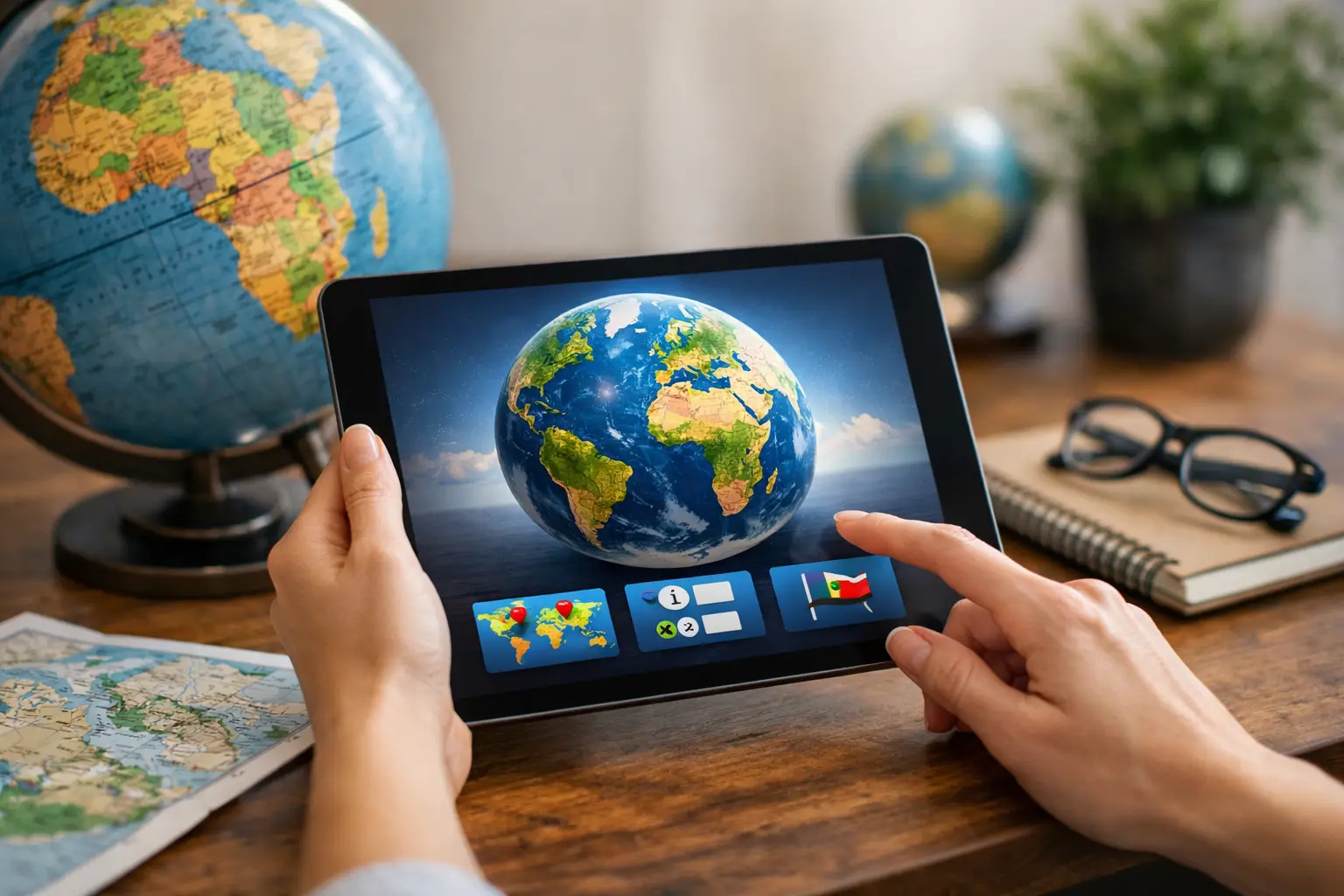
Picking a geography app sounds easy until you open the store and find the same promise over and over: learn flags, memorize capitals, get smarter fast. The best world geography learning app is not the one with the biggest map or the longest feature list. It’s the one you’ll actually come back to tomorrow.
That matters more than people think. Geography sticks when you see it often, guess actively, make a few mistakes, and get quick feedback. If an app feels like homework after two days, it doesn’t matter how many countries it includes. If it turns learning into a small daily win, you’re much more likely to remember where Bhutan is, which flag belongs to Chad, or how far Peru sits from Ecuador.
What makes the best world geography learning app?
A good geography app teaches more than one kind of fact. Countries, flags, capitals, borders, and map position all support each other. If you only study one category, your knowledge can stay oddly shallow. You might recognize Japan’s flag instantly but blank on Tokyo, nearby countries, or where the islands sit on a world map.
The strongest apps build those connections without slowing you down. They give you short rounds, fast guesses, and clear corrections. You answer, see the result, and move on. That rhythm matters because geography is a pattern-recognition subject. Repetition works better when it feels like play.
Another key test is friction. If you need to create an account, sit through onboarding screens, or fight clutter before the first question, most casual learners will bounce. Students on a study break, teachers filling five spare minutes, and puzzle fans looking for a daily challenge want to start right away. The best experience is usually the one that lets you begin in seconds.
Best world geography learning app features that actually help
The feature list sounds obvious at first, but some details matter more than others. A world map quiz is useful, but only if the app shows you the correct answer clearly and gives you another shot later. A flag mode is fun, but only if the flags are presented in a way that encourages memory instead of random tapping.
Daily play is one of the most underrated features. When there’s a fresh challenge every day, geography becomes a habit instead of a cramming session. You stop thinking, “I should study world capitals sometime,” and start thinking, “Let me do today’s round.” That shift is small, but it changes retention.
Variety matters too. Flags sharpen visual memory. Capitals build recall. Mystery-country clues teach context. Distance and direction games train spatial thinking in a way standard flashcards never do. When an app mixes modes, you’re less likely to plateau.
Leaderboards and score sharing can help, but only if they stay light. Friendly competition is great for motivation. Nobody needs a stressful geography grind. The sweet spot is a system that gives you something to compare without making the whole experience feel like ranked multiplayer.
The trade-off between game feel and serious study
Some apps lean heavily into classroom-style learning. They’re structured, thorough, and useful if you need to prepare for a test. The downside is that they can feel rigid. You may learn a lot in one session and then never open the app again.
Others go all-in on game mechanics. These are better at building a streak, but sometimes they skip depth. You get good at the game without building a broader mental map of the world.
That’s why the best option depends on your goal. If you’re a teacher assigning practice, a more structured tool may be right. If you’re a casual learner or puzzle fan, game-first design usually wins because consistency beats intensity. Ten minutes a day for a month often teaches more than one overambitious weekend.
What to look for if you want fast progress
If your goal is to improve quickly, focus less on flashy design and more on learning loops. The app should ask you to recall information before showing the answer. Recognition is easier than recall, but recall is what makes knowledge last.
It also helps when mistakes are useful instead of punishing. The best geography tools tell you what the correct country was, show where it is, and give you enough context to remember it next time. A wrong answer should feel like feedback, not failure.
Short sessions are another advantage. Geography works well in bursts because the content is naturally chunked. One flag. One capital. One map location. One clue set. An app that respects that rhythm fits better into real life and gets used more often.
For many people, browser-based play is especially strong here. No install, no update cycle, no storage issues, no account wall. You just open it and start. That simplicity is easy to underestimate until you compare it with apps you meant to use but never quite launched.
Who needs which kind of geography app?
Students usually benefit from breadth first. They need an app that covers maps, capitals, and flags so classroom knowledge connects across categories. A single-mode app can help with memorization, but it may not support broader coursework.
Trivia players often want speed and surprise. They tend to stick with apps that create repeatable challenge loops instead of textbook progression. Daily puzzles, streaks, and limited tries work especially well for this group because every round feels distinct.
Travelers and lifelong learners usually want context. They’re less interested in acing a quiz and more interested in building a stronger picture of the world. For them, apps that combine country hints, neighboring nations, and map placement feel more satisfying than straight flashcards.
Teachers sit in a different category. They need something students can access quickly and use without technical friction. Free tools with simple rules often win here, especially when they’re easy to project, easy to explain, and easy to revisit.
Why simple usually beats comprehensive
A lot of geography products try to impress you with scale. Hundreds of levels. Multiple regions. endless categories. That can sound great, but it often creates a strange problem: too much choice, not enough momentum.
Simple design tends to perform better because it removes excuses. One clear challenge. Fast feedback. A reason to come back. That formula works because geography learning is cumulative. You don’t need to conquer the planet in one session. You need regular exposure that keeps stacking.
This is also where lightweight daily geography games have an edge. A focused challenge can teach one memorable thing today and another tomorrow. Over time, those small wins create a real map in your head.
One good example of this style is Flagdle, which keeps the barrier low with free, no-account-required geography play and mixes flags with capitals, country clues, and other short challenge modes. That kind of setup works well for people who want learning to feel instant instead of scheduled.
Red flags when choosing the best world geography learning app
If an app relies mostly on passive reading, expect weaker recall. If it hides useful modes behind a paywall before you can tell whether the format works for you, be cautious. And if the interface is crowded enough that starting a round feels like a task, that friction adds up fast.
Another issue is narrow repetition without context. Memorizing a flag by color blocks alone can help in the short term, but it’s less durable if you never connect that flag to location, neighbors, or capital. Good geography learning builds layers.
Be wary of apps that turn every mistake into a dead end. The best tools make wrong answers part of the lesson. They keep you moving, keep you curious, and make the next attempt easier.
So which app is actually best?
The honest answer is that the best world geography learning app is the one that matches how you learn and how you live. If you want deep study sessions, choose structure. If you want a daily habit that sticks, choose speed, variety, and low friction. If you’re trying to build real long-term memory, choose active recall over passive browsing every time.
A great geography app should make you want one more round. Not because it tricks you into staying, but because it makes learning feel sharp, quick, and satisfying. That’s the bar.
If you’re deciding between a polished study tool and a simple daily challenge, don’t just ask which one teaches more on paper. Ask which one you’ll still be using next week. Geography gets better with repetition, and the smartest tool is often the one that makes showing up easy.
Start there, stay consistent, and let small daily guesses do the heavy lifting.